


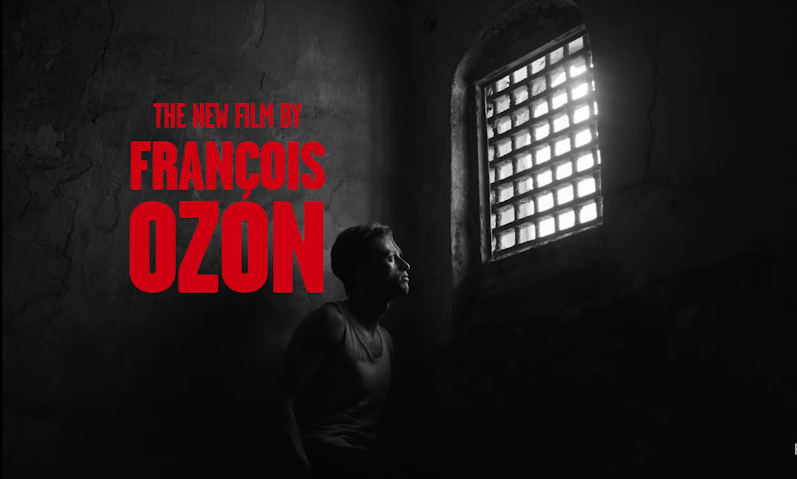
Let’s address the sun-drenched elephant on the beach immediately.
François Ozon adapts Albert Camus’s L’Étranger—a novel so sacred in French culture that adapting it feels like volunteering to perform open-heart surgery on a national monument while everyone watches. The 1942 novella has sold millions of copies, appeared on countless syllabi, and spawned exactly one previous major film adaptation: Luchino Visconti’s 1967 version starring Marcello Mastroianni .
Ozon throws himself into the task with what he calls “a certain light-heartedness.” The result? A “lustrously beautiful, superbly realised monochrome” film that earned multiple Lumière Awards including Best Film, Best Actor (Benjamin Voisin), and Best Cinematography . Pierre Lottin also won the César Award for Best Supporting Actor for his work here .
The film arrives in US theaters on April 3, 2026, via Music Box Films, after premiering in competition at the Venice Film Festival and opening New York’s Rendez-Vous with French Cinema .
This is not background viewing. This is cinema that asks you to sit in discomfort and wonder why you feel nothing—or everything.
What Is The Stranger Actually About?
The plot, faithful to Camus’s novel, proceeds with deceptive simplicity.
Meursault (Benjamin Voisin) works as a clerk in 1930s Algiers during French colonial rule. He keeps to himself. He causes no trouble. When his mother dies, he attends her funeral but cannot manufacture the grief society expects from him .
He returns to his routine. He swims. He watches movies. He begins a casual romance with Marie Cardona (Rebecca Marder), a former typist who finds his detachment puzzling but magnetic. He befriends Raymond Sintès (Pierre Lottin), a neighbor with a violent reputation and trouble with the local Arab community .
Then comes the beach.
The sun beats down. The light reflects off a knife. Meursault fires a gun—once, then four more times into an already-dead body. “I killed an Arab,” he later tells the court, offering no explanation beyond the heat and glare .
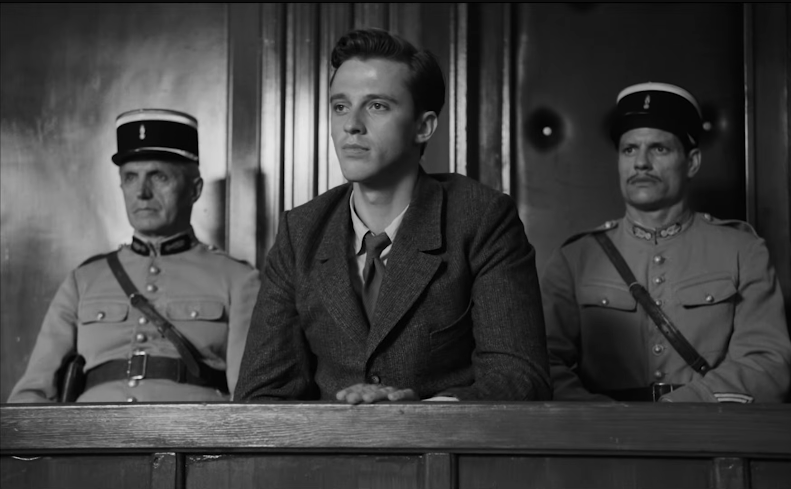
The novel’s first half ends here. The second half shifts to Meursault’s trial, where prosecutors care less about the murder than about his failure to cry at his mother’s funeral. Colonial French society cannot forgive his indifference. It can forgive a dead Arab. It cannot forgive a man who refuses to perform emotion .
Benjamin Voisin: A Performance of Strategic Emptiness

Let’s be clear about what makes this adaptation work.
Benjamin Voisin plays Meursault as a void that somehow feels full. This is the same actor who broke out in Ozon’s Summer of 85 and earned César attention for Lost Illusions . Here, he does something harder than emoting. He refuses to emote while somehow remaining watchable for two hours.
Jessica Kiang of Variety praised the performance as “a superb portrait of disaffection,” noting how Voisin preserves the novel’s “unsettling moral void” while remaining “faithful to its haunting mystery” .
The key distinction lies in how Voisin differs from Marcello Mastroianni’s 1967 portrayal. The Film Stage noted that Mastroianni, for all his technical brilliance, brought “empathetic, hot-blooded” energy to Meursault—fundamentally misunderstanding Camus’s character. “Meursault is not supposed to be empathetic or hot-blooded; every time Mastroianni pulls at your heartstrings with those earnest, teary eyes, it’s undermining Camus’ chilled, quietly shocking worldview” .
Voisin offers no such comfort. He looks at the world with clear, unblinking eyes. He answers questions honestly. He never performs. Ozon himself described Meursault as “a filmmaker”—someone who observes others acting their lives while refusing to “play along” .
This interpretation honors Camus’s central insight: Meursault is not a monster. He simply lacks the instinct to lie.
The Colonial Context: Ozon’s Boldest Addition
Here is where Ozon departs from previous adaptations and earns both praise and controversy.
The novel, written by a pied-noir (French Algerian) in 1942, famously never names the Arab victim. The dead man exists as a plot device—a faceless catalyst for Meursault’s existential crisis. Generations of readers and critics have wrestled with this erasure. How can a novel about justice and absurdity ignore the actual human being whose death sets everything in motion?
Ozon addresses this directly. His adaptation restores the victim’s humanity, giving his sister Djemila a presence in the film’s closing moments. The final scene departs from Camus’s text: after Meursault accepts his death, the camera shifts to Djemila mourning her brother—a man who received no justice, whose name the court barely spoke .
Catherine Camus, the author’s daughter and literary executor, reportedly disagreed with this addition, describing it as “appealing to wokeism” . She controls the rights to her father’s work and required convincing before greenlighting any adaptation. Ozon had to work to earn her trust. “I was aware of the responsibility that fell on me,” he said .
But the change accomplishes something vital. It acknowledges that French colonialism created the conditions for Meursault’s crime. A Frenchman could shoot an Arab in 1930s Algeria and face trial not for murder but for failing to grieve properly. The victim’s humanity vanished into legal procedure. Ozon’s ending restores what Camus’s novel—deliberately or not—erased.
The Ticker review captured this dynamic well: “The ending drives the point that even after Meursault is gone, there are still open wounds from the woman who has to mourn her murdered brother without true justice being served. Ozon put a refocus on how French Colonialism affected Algeria and the invisibility of the indigenous” .
Rebecca Marder and the Reinvention of Marie
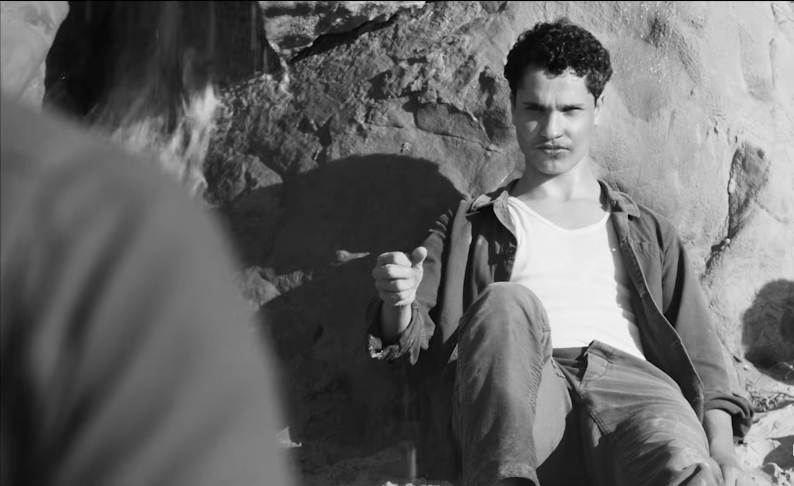
Marie Cardona presents a unique challenge for any adapter of The Stranger.
In Camus’s novel, Marie exists primarily as a body. Meursault describes her physically—her breasts, her tan, the way she moves—but rarely as a consciousness. She wants to marry him. He agrees, because why not? Readers never learn why she pursues a man so clearly incapable of returning her affection.
Rebecca Marder worked directly with Ozon to build Marie a soul. “We know she’s a secretary and so she’s a modern woman,” Marder explained. “It was all about giving her a soul because she’s described as flesh and she’s in really sensual scenes” .
The result transforms Marie from object to witness. Marder plays her as the “guardian of empathy” alongside Djemila—two women who feel everything Meursault cannot . Every lively emotion Marder displays meets Voisin’s immovable distance. The only moments of genuine connection occur during physical intimacy, when bodies communicate what words and feelings cannot.
This creative choice elevates the film beyond mere adaptation. Ozon and Marder recognize that Camus’s existential concerns—absurdity, alienation, the meaninglessness of existence—cannot fully account for the gendered experience of colonial Algeria. Marie may love a man who cannot love her back. That is her absurd condition. The film grants her dignity that the novel largely denied.
The Black-and-White Cinematography: Heat You Can Feel
Cinematographer Manu Dacosse earns every award this film has collected.
The black-and-white photography does not simply look beautiful. It creates physical sensation. The Mediterranean sun becomes a character—blinding, oppressive, inescapable. Jordan Mintzer of The Hollywood Reporter described the imagery as “stunningly high-contrast black-and-white… plunging us into a Mediterranean world of sea, sex and sun that’s enchanting until it becomes unbearable” .
The 4:3 aspect ratio evokes classic cinema while trapping characters within a frame that feels increasingly claustrophobic . Meursault cannot escape his circumstances. Neither can the audience.
Dacosse captures specific visual moments that Camus’s readers have imagined for decades: the sun glare off the knife blade, the sweat on Meursault’s forehead during the funeral procession, the white-hot sand of the beach. The Ticker noted that “many users commented that the film’s snippets the trailer showed was exactly the way they pictured various scenes playing out in their heads” .
This is adaptation as fulfillment. Ozon and Dacosse translate Camus’s prose into images so precise they feel inevitable.
The Supporting Cast: A French Cinema All-Star Team
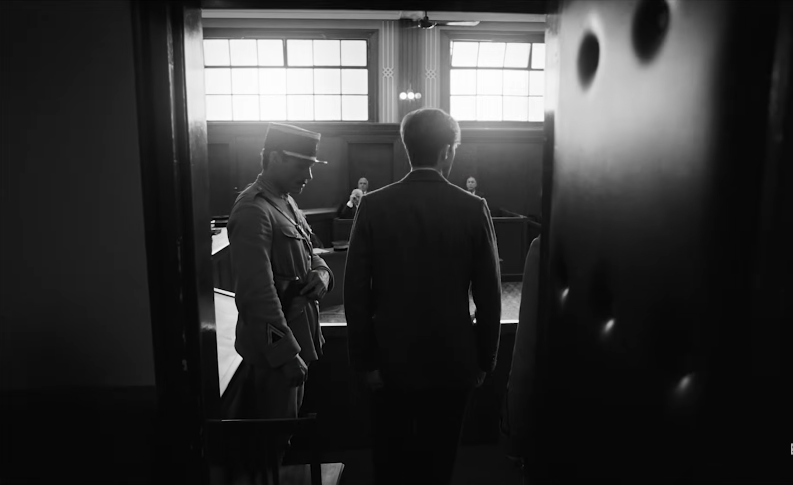
Ozon assembles a supporting cast that reads like a who’s-who of contemporary French acting.
Pierre Lottin (The Night of the 12th) plays Raymond Sintès, the volatile neighbor who drags Meursault into his conflicts. Lottin won the César Award for Best Supporting Actor for this performance, and watching him work clarifies why . His Raymond vibrates with threat—a man whose violence simmers beneath a thin veneer of friendship.
Denis Lavant, the legendary physical performer from Leos Carax’s Holy Motors and Beau Travail, appears as Salamano, the old man who abuses and then mourns his dog. Lavant brings decades of embodied performance to a small but devastating role .
Swann Arlaud (Anatomy of a Fall) plays the prison chaplain who visits Meursault before his execution. Their confrontation—in which Meursault finally explodes at the priest’s insistence on meaning and salvation—provides the film’s emotional climax. Arlaud matches Voisin’s intensity, creating a scene that justifies the entire adaptation .
Christophe Malavoy and Nicolas Vaude round out the cast as the judge and prosecutor respectively—men whose incomprehension of Meursault’s honesty becomes its own form of violence .
The Ozon Touch: 27 Features and Counting
The Stranger marks Ozon’s 27th feature film . Few directors working today can claim comparable output combined with consistent critical regard.
His career spans genres and tones with restless curiosity. Swimming Pool (2003) explored erotic obsession. 8 Women (2002) delivered a star-studded musical murder mystery. By the Grace of God (2018) examined sexual abuse in the Catholic Church with documentary precision. Frantz (2016) offered a black-and-white period drama about grief and forgiveness .
This versatility explains why Ozon could approach The Stranger with confidence. He has made comedies, thrillers, musicals, and social dramas. A philosophical adaptation of canonical literature represents just another challenge—one he meets with characteristic precision.
The film’s 120-122 minute runtime (sources vary slightly) never drags . Ozon maintains tension through restraint. He trusts Camus’s story. He trusts Voisin’s face. He trusts the audience to sit with discomfort rather than demanding resolution.
The Score: Fatima Al Qadiri’s Sonic Landscape
Special attention belongs to Fatima Al Qadiri‘s original score.
The Kuwaiti-born composer and artist brings a distinctive sensibility to Ozon’s adaptation. Her previous work spans electronic music, installation art, and film scoring. Here, she creates sound that mirrors Meursault’s internal state—sparse, repetitive, occasionally erupting into something more urgent before settling back into ambient drift .
The score never overwhelms. It underpins. It creates space for silence, which the film uses generously. Meursault’s world is quiet until violence shatters it. Al Qadiri’s music respects that dynamic.
What Works (And What Tests Patience)
Let’s break this down honestly.
Reasons to watch:
- Benjamin Voisin’s performance. He achieves what Mastroianni could not—a truly Camusian Meursault.
- The black-and-white cinematography. Manu Dacosse creates images that will linger in memory.
- The colonial corrective. Ozon restores visibility to the Arab victim without betraying Camus.
- Rebecca Marder’s Marie. She transforms a sketch into a human being.
- The supporting cast. Lavant, Lottin, Arlaud—everyone delivers.
Reasons to hesitate:
- The pacing. This is a deliberately paced philosophical drama. Action seekers should look elsewhere.
- The ending. Catherine Camus is not wrong that the addition changes Camus’s meaning. Purists may object.
- The French language. English subtitles require reading. Some viewers prefer dubs (not available).
- The emotional temperature. Meursault’s detachment may frustrate viewers who need characters to emote.
The Existential Weight: Why This Story Still Matters
Why adapt The Stranger in 2026?
Because Camus’s questions have not aged. What does it mean to live honestly? What happens when society demands performances of grief, patriotism, belief—and you cannot provide them? What justice exists for those whose deaths matter less than the feelings of their killers?
Ozon’s adaptation arrives at a moment of renewed interest in existentialist thought. Climate anxiety, political instability, and social fragmentation have made Camus’s absurdism feel less like philosophy and more like daily experience. Meursault’s refusal to lie—his insistence on describing the world exactly as he experiences it—reads differently in an era of algorithmic curation and performed authenticity.
The film does not offer comfort. It offers clarity. Meursault dies because he will not pretend. The court condemns him not for murder but for honesty. There is no justice. There is only the sun, the sea, and the brief time we have before the lights go out.
Ozon’s film honors this darkness while insisting on something Camus’s novel could not fully acknowledge: that others suffer too, that some deaths matter less than others, that colonialism structures whose grief counts and whose does not.
Should You See The Stranger?
Yes. With appropriately existential expectations.
Go see it if:
- You read Camus in college and want to see a faithful yet thoughtful adaptation.
- You appreciate black-and-white cinematography that earns its aesthetic choices.
- You follow contemporary French cinema and trust Ozon’s instincts.
- You want to watch Benjamin Voisin announce himself as a major international star.
Skip it if:
- You need fast pacing, clear resolution, or emotional catharsis.
- Subtitles fatigue you.
- The novel’s philosophical concerns leave you cold.
- You prefer Visconti’s warmer, more empathetic Meursault.
Verdict: The Stranger is a haunting, formally impeccable adaptation that honors Camus while expanding his vision. It earns its 89% Rotten Tomatoes score and its Lumière Awards sweep. Voisin delivers the definitive screen Meursault. Ozon proves, for the 27th time, that he can handle any genre, any source material, any challenge French cinema throws at him.
The film runs 120-122 minutes and carries an NR rating (violence, nudity, and sexual situations) . Music Box Films distributes in theaters nationwide beginning April 3, 2026, with Oklahoma City screenings following on April 17 .
Bring sunscreen. The heat is real.
Rating: ★★★★☆ (4/5)
Runtime: 120-122 minutes
Rating: NR (violence, nudity, sexual situations)
Director: François Ozon
Writers: François Ozon, Philippe Piazzo (based on the novel by Albert Camus)
Cast: Benjamin Voisin, Rebecca Marder, Pierre Lottin, Denis Lavant, Swann Arlaud, Christophe Malavoy, Nicolas Vaude
Cinematography: Manu Dacosse
Original Score: Fatima Al Qadiri
Release Date: April 3, 2026 (US theaters)
Distributor: Music Box Films
Language: French, Arabic, Latin with English subtitles
Awards: Lumière Awards (Best Film, Best Actor, Best Cinematography); César Award (Best Supporting Actor – Pierre Lottin)
Review Overview
- Rating8











Leave a comment