


A Love Story That Rewrote the Record Books
Bollywood has been hungry for a great love story. Not a romantic comedy, not a masala-coated affair, and certainly not another hypermasculine action film with a token romance subplot — but a full-throated, soul-drenching, tearjerker of a love story that reminds you why cinema was invented in the first place. With Saiyaara, director Mohit Suri and Yash Raj Films deliver precisely that — and the audience has responded with staggering enthusiasm.
Released on July 18, 2025, Saiyaara stars two complete newcomers — Ahaan Panday and Aneet Padda — and went on to become the highest-grossing Indian romantic film of all time at the worldwide box office. That achievement, extraordinary on its own terms, becomes even more remarkable when you consider it was accomplished by two debutants with virtually no pre-release promotion, on a comparatively modest budget. Saiyaara is not just a movie; it is a cultural moment, a reassertion that emotional authenticity still sells, and that Bollywood romance — long considered an endangered genre — is very much alive.
This review examines everything that makes Saiyaara work: its story, performances, music, direction, thematic depth, and the larger conversation it opens about the future of Hindi cinema.
Director: Mohit Suri
Cast: Ahaan Panday, Aneet Padda, Geeta Agarwal Sharma, Rajesh Kumar
Screenplay: Sankalp Sadanah (story), Rohan Shankar (dialogues)
Music: Mithoon, Tanishk Bagchi, Sachet–Parampara, Vishal Mishra, The Rish, Faheem Abdullah, Arslan Nizami
Producer: Yash Raj Films (Akshaye Widhani)
Runtime: 2 hours 36 minutes
Streaming: Netflix (from September 12, 2025)
Our Rating: ★★★★ / 5
Plot Overview: Music, Memory, and Alzheimer’s
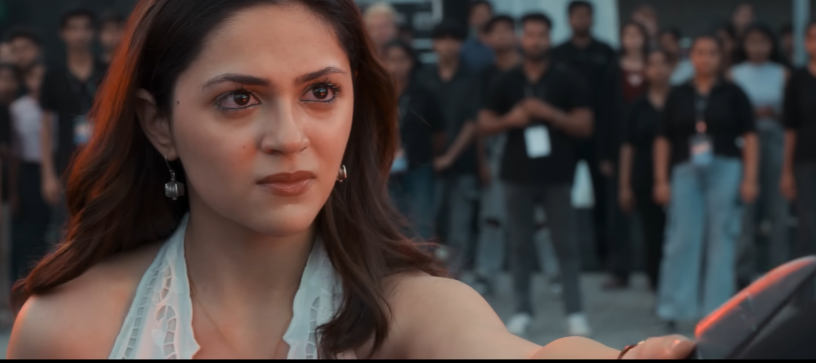
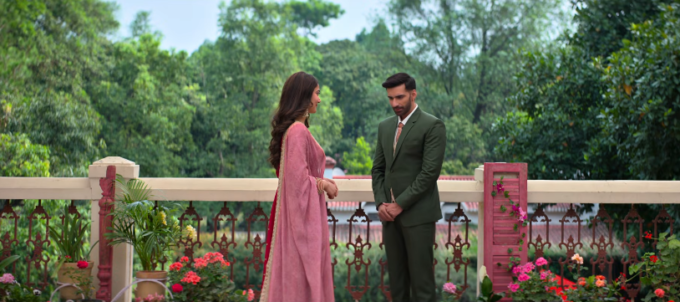
Saiyaara centres on two intensely driven creative souls — Krish Kapoor (Ahaan Panday), a volatile and charismatic singer with an estranged family and a chip on his shoulder, and Vaani Batra (Aneet Padda), a songwriter from Amritsar who arrives in Mumbai carrying her own invisible wounds. Her boyfriend left her at the altar. She cannot write anymore. He rages at the world because the world refuses to truly hear him.
Their collision — electric, inevitable, beautifully staged — sets the film’s first half in motion. Director Mohit Suri, working from Sankalp Sadanah’s script with dialogues by Rohan Shankar, smartly uses the two characters’ creative partnership as the engine of their romance. Krish’s voice finds direction through Vaani’s words; her words find a reason to exist through his music. Together, they compose something greater than either could alone.
Then, at the interval, Saiyaara executes one of the boldest narrative pivots in recent Bollywood memory. Vaani is diagnosed with early-onset Alzheimer’s disease. Suddenly, the film’s entire emotional architecture shifts. The stakes are no longer about whether these two people will end up together — they are about whether love is strong enough to outlast memory itself. It is a brave, precise structural choice, and it pays off profoundly.
Loosely inspired by the 2004 South Korean film A Moment to Remember, Saiyaara nonetheless carves its own identity. The Korean film’s emotional DNA is present, but Suri and his team Indianise the material with a musicality and visual language that is entirely their own. The result draws comparisons to Imtiaz Ali’s Rockstar (2011) and the global touchstone The Notebook (2004), but ultimately Saiyaara operates in its own emotional register.
Performances: Two Debuts That Demanded Attention
Ahaan Panday as Krish Kapoor
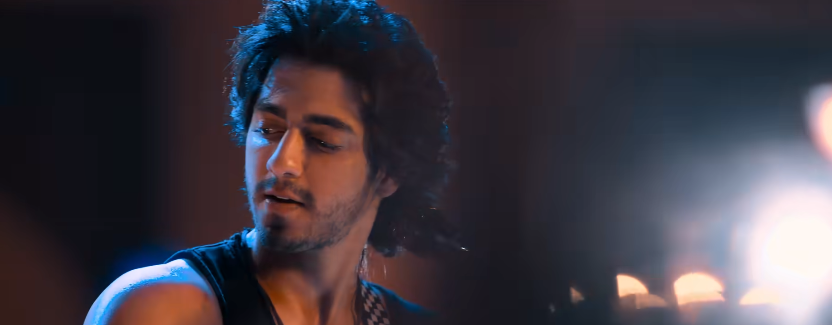
Ahaan Panday, nephew of Chunky Panday and cousin of Ananya Panday, carries the full weight of Bollywood’s nepo-kid scrutiny into his first film — and emerges with considerable grace. His Krish Kapoor begins as a recognisable archetype: the brooding, entitled, tortured artist who smokes too much and storms into offices to confront journalists who overlooked his band in a review. Panday plays this aggression with conviction, but what he does in the film’s second half is far more impressive.
As Vaani’s diagnosis reshapes the story’s moral centre, Krish is forced to evolve from a man who makes art to be remembered into a man consumed by the fear of being forgotten by the person he loves most. That emotional journey — from self-absorption to selfless devotion — demands range, and Panday delivers it. His Krish sprints, broods, breaks down, and ultimately surrenders his own ego in service of their love. There is something vintage and cinematic about his screen presence — a quality that recalls the old Bollywood heroes who commanded attention simply by walking into the frame.
Crucially, Panday’s initial audition did not impress Mohit Suri. It was an informal dinner and a follow-up conversation that changed the director’s mind. That off-screen authenticity translates into something real on screen.
Aneet Padda as Vaani Batra
If Ahaan Panday’s performance is about presence, Aneet Padda’s is about interiority. Her Vaani Batra is a woman who knows she exists at the margins of her own story — a muse, a collaborator, a middle-class Punjabi girl from Amritsar who dresses her pain in diaries and lyrics. Padda, who previously appeared in the digital series Big Girls Don’t Cry (2024), lends Vaani a literary, almost literary-critical self-awareness. She plays a woman who understands the burden of being a protagonist and struggles to accept it.
The film opens on Vaani, not Krish — she arrives for a court marriage, scribbling in her diary until she runs out of paper. It is a masterstroke of framing: the woman who loses her memory begins the film writing, determined to record herself into permanence. Padda honours that subtext at every turn. When the Alzheimer’s diagnosis arrives, she does not play it as a sudden collapse. Instead, she shows us the small, quiet erosions — the pauses before familiar names, the flicker of confusion quickly masked — that make the second half so devastating.
Mohit Suri famously spent over four months searching for his female lead, seeking a young actress who felt “untouched” — someone with a natural, unaltered authenticity. When Padda auditioned in a yellow dress (mistakenly thinking it was the character’s costume), her unguarded quality won over the room. That quality defines her performance throughout.
Chemistry and Ensemble
The chemistry between Panday and Padda is the film’s biggest asset and arguably the reason it became a cultural phenomenon. Their pairing feels unscripted, spontaneous — the kind of on-screen partnership that generates viral reels not because of stylised moments, but because of small, genuine ones. The supporting cast, including Geeta Agarwal Sharma and Rajesh Kumar, provides solid scaffolding without ever threatening to steal focus from the central duo.
Direction: Mohit Suri’s Finest Hour
Mohit Suri has spent two decades making films where the music outlasted the movie. Zeher (2005), Awarapan (2007), Aashiqui 2 (2013), Ek Villain (2014) — each generated soundtracks so addictive that the films themselves became footnotes to their own albums. With Saiyaara, Suri finally achieves what had always eluded him: a film where the story and the music are inseparable, each amplifying the other until the whole becomes genuinely greater than the sum of its parts.
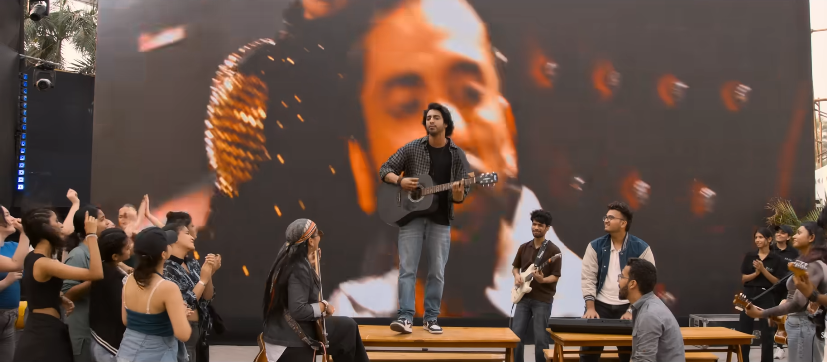
Several directorial choices stand out. Suri uses songs not as interludes but as extensions of psychological state — a technique he has always aspired to but never executed this cleanly. A time-lapse montage set to the title track captures Krish’s grief across multiple concert venues with a single moving shot. A later sequence places Krish running and collapsing in a stadium, ending as a silhouette against a pixelated close-up of Vaani’s eyes on a jumbotron. These moments reveal an artist operating at the intersection of mass entertainment and genuine artistic ambition.
The YRF influence matters here too. Saiyaara marks Suri’s first collaboration with Yash Raj Films, and the partnership clarifies something: YRF’s institutional confidence in hero gestures and sweeping emotion gives Suri’s instincts a structural container they had previously lacked. The result is his most disciplined, most emotionally precise film to date.
The script does stumble occasionally — most notably in the re-introduction of Vaani’s ex-boyfriend as a late-act villain, a device that feels borrowed from an earlier, less sophisticated draft. The film’s 156-minute runtime also tests patience in spots. However, neither weakness is severe enough to derail the larger emotional experience.
Music and Soundtrack: The True North Star
A Mohit Suri film lives and dies by its music, and Saiyaara delivers one of Bollywood’s richest soundtracks in years. The album features seven composers — Mithoon, Tanishk Bagchi, Sachet–Parampara, Vishal Mishra, The Rish (Rishabh Kant), Faheem Abdullah, and Arslan Nizami — alongside lyricists including Irshad Kamil, Mithoon himself, Raj Shekhar, and Rishabh Kant. This multi-composer structure, unusual for a YRF production, results in a soundtrack with genuine sonic variety that nonetheless maintains a consistent emotional tone.
The title track, composed by Tanishk Bagchi and sung by Arijit Singh, functions as the film’s emotional heartbeat. It has accumulated hundreds of millions of streams and turned cinema halls into spontaneous concert venues, with audiences singing along in real time. Barbaad, composed by The Rish and sung by Jubin Nautiyal, provides a breezy counterpoint. Humsafar by Sachet–Parampara, with its haunting waltz metre and layered guitar work, has emerged as a quiet favourite among repeat viewers. Tum Ho Toh, composed by Vishal Mishra, benefits from soulful cinematography that elevates it from song to emotional statement.
Suri has described the album as a tribute to the soundtrack of the original Aashiqui (1990), and that lineage is audible — not as imitation, but as inheritance. The music does not merely accompany the film; it narrates it.
Thematic Depth: Love, Memory, and the Terror of Being Forgotten
Saiyaara operates on a theme that is simultaneously intimate and universal: the fear of being forgotten by the one person who matters most. Alzheimer’s disease, in mainstream cinema, often functions as melodrama shorthand — a convenient tragedy that generates tears without demanding engagement. Suri and Sadanah refuse that shortcut.
Instead, they use the disease to reverse the film’s moral architecture. In the first half, Krish is the one who makes art to be remembered — his ambition is fundamentally about legacy, about leaving a mark. The diagnosis, by stripping Vaani of the ability to remember, strips Krish of his original ambition’s foundation. He can no longer perform for legacy because the person he loves is losing the capacity to receive it. He must instead perform for her — in the present tense, every day, against diminishing returns.
This inversion is the film’s most sophisticated achievement. It transforms the archetypal Bollywood hero — entitled, intense, defined by masculine ambition — into something rarer: a man who learns to be selfless not because the plot requires it, but because love demands it. The film’s treatment of caregiving and sacrifice avoids sentimentality because it grounds both in specific, credible human behaviour.
The film also engages quietly with questions about creative partnership, artistic co-dependence, and what it means to make something beautiful with someone who may not remember you made it. These are not questions mainstream Hindi cinema typically explores, and Saiyaara earns its right to ask them.
Box Office Performance: History Made by Newcomers
Saiyaara‘s commercial performance is, by any measure, extraordinary. According to data from Sacnilk and Koimoi, the film’s final worldwide gross exceeded ₹570 crore, making it the highest-grossing Indian romantic film ever made and the second highest-grossing Bollywood film of 2025, trailing only Chhaava.
Key Box Office Records Set by Saiyaara:
- Highest opening day for a debutant-led Indian film: ₹21.5 crore net
- Highest opening for any Indian romantic film — surpassing Kabir Singh (₹20.21 crore net)
- Highest opening weekend for a debutant-led Indian film: ₹83.25 crore net
- Highest-grossing Indian romantic film at the overseas box office — beating Chhaava (₹93 crore)
- ROI of 650% on a reported budget of ₹45 crore — the second most profitable Bollywood film of 2025
- 1.85 crore tickets sold in India, underscoring extraordinary repeat viewing
The overseas performance deserves special mention. With unknown faces at the top of the bill and minimal pre-release promotion, Saiyaara generated ₹171.5 crore in international markets, with the UK, Canada, and Australia emerging as key territories. As Deadline reported, the film performed like a top-star vehicle in international markets — an outcome that surprised even the most optimistic trade analysts.
Notably, Yash Raj Films and Mohit Suri made the deliberate decision not to promote Ahaan Panday and Aneet Padda before release, preferring audiences to encounter the pair for the first time on screen. That gamble paid off spectacularly.
Critical Consensus: What Other Critics Said
Saiyaara has attracted broadly positive critical notices, with particular praise for the performances, the music, and Suri’s direction. The consensus acknowledges the film’s familiar story architecture while celebrating its emotional execution.
Rishil Jogani of Pinkvilla (3.5/5) praised the film’s “stellar performances, enchanting music, and Mohit Suri’s masterful direction.” Rishabh Suri of Hindustan Times (3.5/5) noted that the film “strikes the right emotional chords” and “understands its audience.” Vineeta Kumar of India Today (3.5/5) observed that Saiyaara “doesn’t promise the best love story” but “holds your hand, sings to your broken heart.”
Radhika Sharma of NDTV (3/5) acknowledged the familiar story while praising the execution, and Kusumika Das of Times Now (2.5/5) offered the most measured view, noting that the film “aimed for the stars and only touched the clouds” in places.
The IMDB score of 6.3, while modest, reflects a divided audience response — those who find the familiar romance template insufficient, and those (clearly the majority, given the box office) who find it precisely sufficient. The film’s digital streaming on Netflix from September 12, 2025, will expose it to new audiences and will likely generate a second wave of conversation.
Why Saiyaara Signals a Turning Point for Bollywood Romance
The success of Saiyaara invites a larger question about the state of Hindi cinema. The genre of emotional romantic drama — the tearjerker that made Bollywood what it was through the 1990s and 2000s — had largely been abandoned in favour of hypermasculine action films, remakes, and self-consciously edgy content. Saiyaara demonstrates, with the clarity of ₹570 crore in receipts, that the audience for genuine romantic cinema never disappeared. It was simply underserved.
Several factors explain the film’s cultural resonance:
The music pre-loaded emotion. By releasing five singles before the film arrived, YRF Music allowed audiences to form emotional attachments to the story before a single frame was screened. People arrived in cinemas already primed to feel.
The debutants felt real. In an industry where most newcomers arrive pre-polished and PR-managed, Panday and Padda presented as genuine — unprocessed, slightly raw, convincingly in love. That authenticity gave the film a quality of discovery that established stars rarely generate.
The story respected the audience. Saiyaara does not condescend. It uses Alzheimer’s disease not as exploitation but as a structurally precise device that genuinely complicates and enriches its characters. Audiences, particularly younger ones who have been handed a diet of increasingly derivative content, respond to that kind of respect.
Tier-2 and Tier-3 city audiences drove the numbers. Cities including Jaipur, Lucknow, Bhopal, and Surat showed notable turnout, reflecting the film’s emotional accessibility across demographic and geographic lines. Universal themes of first love, loss, and devotion travel, and Saiyaara understood that.
Frequently Asked Questions About Saiyaara (2025)
Is Saiyaara based on a true story?
No. It is a work of fiction loosely inspired by the 2004 South Korean film A Moment to Remember.
Where can I watch Saiyaara online?
Saiyaara began streaming on Netflix from September 12, 2025. Satellite rights were acquired by Sony Max.
What is the Saiyaara total worldwide box office collection?
The film concluded its theatrical run with a worldwide gross of approximately ₹570 crore, making it the highest-grossing Indian romantic film of all time.
Who composed the Saiyaara title track?
The title track was composed by Tanishk Bagchi and sung by Arijit Singh.
Is Saiyaara Ahaan Panday’s debut film?
Yes. Saiyaara marks Ahaan Panday’s Bollywood debut.
Was Saiyaara originally planned as a sequel to Aashiqui 2?
According to Wikipedia, it was originally conceived as a spiritual sequel to Aashiqui 2 (2013), but creative differences with the original producers led to it being reworked as a standalone film under Yash Raj Films.
Verdict: Bollywood Romance Done Right
Saiyaara is not a perfect film. Its 156-minute runtime tests patience in the third act, a subplot involving Vaani’s ex-boyfriend feels obligatory, and certain scenes lean into melodrama that the material does not strictly require. However, these are the minor imperfections of a film that gets the big things exactly right: the emotional architecture of its central relationship, the structural courage of its interval twist, the precision of its music, and the remarkable authenticity of its two lead performances.
Mohit Suri has made his best film. Ahaan Panday has made a genuinely compelling debut. Aneet Padda has delivered a performance that demands to be seen. And together, they have produced something rare in contemporary Bollywood: a love story that earns its tears, respects its audience, and leaves you walking out of the cinema humming not just a song, but a feeling.
Saiyaara is, finally, a love story to remember.

Saiyaara Review Overview
Summary
Saiyaara movie review: A captivating romantic musical directed by Mohit Suri, starring Ahaan Panday and Aneet Padda. Released July 18, 2025, it tells the story of a singer and a poet with Alzheimer's. Rated 4/5 stars for its emotional depth, exceptional music, and stellar performances. Now streaming on Netflix.
The Pros
Exceptional soundtrack that stays with you long after the film ends Stellar debut performances by both Ahaan Panday and Aneet Padda Mohit Suri's mature direction and visual storytelling Emotional depth that doesn't feel manipulative Beautiful cinematography and production design The Alzheimer's storyline adds genuine weight to the romance Second-half transformation is earned, not forced Strong supporting castThe Cons
Plot feels familiar if you've watched Mohit Suri's previous work Krish's violent behavior early in the film is hard to excuse Some plot holes and conveniences strain believability Runtime of 156 minutes feels slightly stretched The evil ex-boyfriend subplot feels clichéd A few too many coincidences in the narrative- Rating8













Leave a comment