


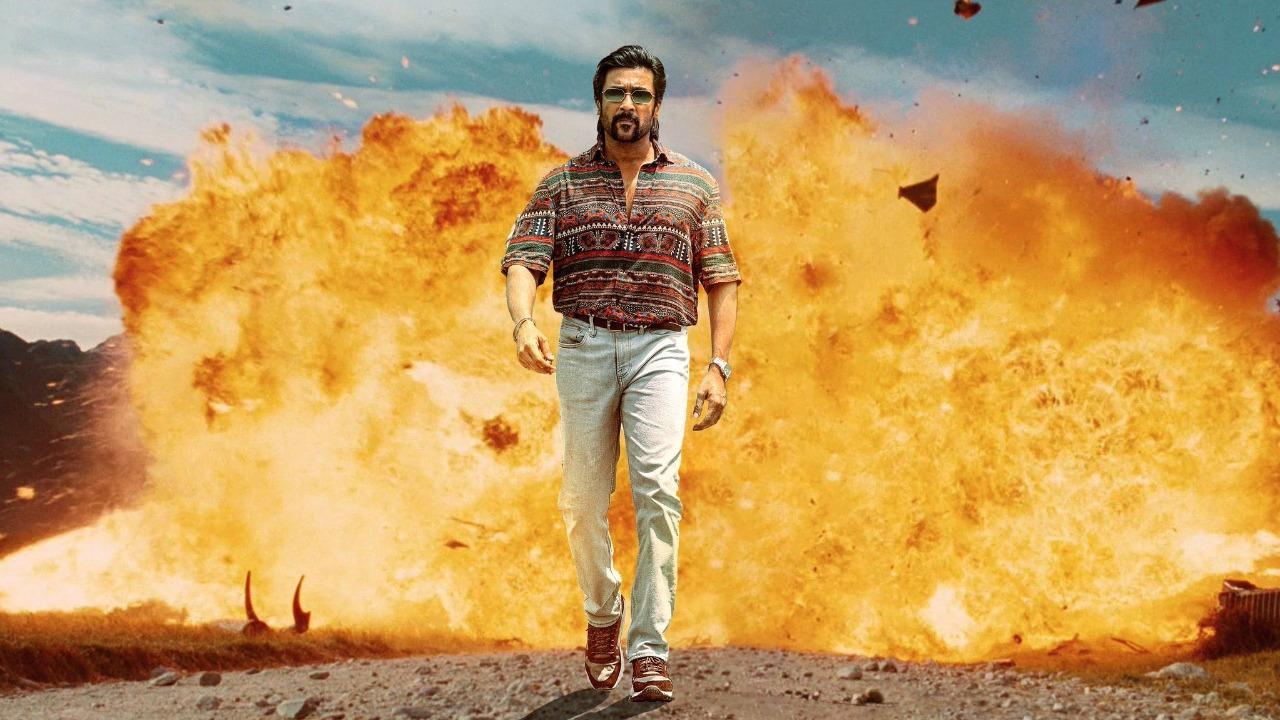
Released theatrically on May 1, 2025 — coinciding with International Workers’ Day — Retro is a Tamil-language romantic action film written and directed by Karthik Subbaraj, one of Tamil cinema’s most inventive contemporary filmmakers. The film stars Suriya as the lead alongside Pooja Hegde, with a powerful supporting ensemble that includes Joju George, Jayaram, Nasser, Prakash Raj, and Shriya Saran.
Produced jointly by Suriya and Jyotika’s 2D Entertainment and Karthik Subbaraj’s Stone Bench Creations, Retro marks the first-ever collaboration between Suriya and Subbaraj — a pairing that generated enormous anticipation among Tamil cinema fans. The film was announced in March 2024 under the working title Suriya 44 and shot across stunning locations including the Andaman and Nicobar Islands, Ooty, Kerala, and Chennai. It was released in Tamil, Telugu, and Hindi simultaneously, with a runtime of 168 minutes (2 hours, 48 minutes).
Following a string of disappointments for Suriya at the box office, Retro arrived as his most anticipated comeback vehicle in years. The result is a film that is simultaneously audacious, emotionally rich in stretches, technically accomplished, and frustratingly uneven — a defining Karthik Subbaraj paradox that critics and audiences have wrestled with in equal measure. The film subsequently premiered on Netflix on May 30, 2025, extending its reach to a global audience.
Quick Facts: Retro (2025) at a Glance
| Detail | Info |
|---|---|
| Director & Writer | Karthik Subbaraj |
| Producers | Jyotika, Suriya (2D Entertainment); Karthik Subbaraj (Stone Bench Creations) |
| Lead Cast | Suriya, Pooja Hegde |
| Supporting Cast | Joju George, Jayaram, Nasser, Prakash Raj, Shriya Saran, Karunakaran |
| Music | Santhosh Narayanan |
| Cinematography | Shreyaas Krishna |
| Editing | Shafique Mohamed Ali |
| Stunt Choreography | Kecha Khamphakdee |
| Audio Rights | T-Series |
| Release Date | May 1, 2025 (Theatrical); May 30, 2025 (Netflix) |
| Formats | Standard & EPIQ |
| Runtime | 168 minutes (2 hrs 48 mins) |
| Certificate | U/A (CBFC) |
| Languages | Tamil (original), Telugu, Hindi |
| Tagline | Love · Laughter · War |
The Story: Paarivel Kannan’s Journey from Violence to Love
Origins: A Child Born Into Violence
Retro opens by establishing one of the most layered protagonists Tamil cinema has seen in recent years. Paarivel “Paari” Kannan (Suriya) is an orphan raised by Thilakan (Joju George), a ruthless gangster deeply involved in smuggling. While Thilakan’s wife, Sandhyamma, raises Paari with warmth and maternal love, Thilakan himself never fully accepts the boy as a son — treating him instead as another enforcer in his criminal empire.
Following Sandhyamma’s death, Paari grows up entirely under the shadow of Thilakan’s violent world. His childhood trauma — beginning with exposure to extreme violence from the moment of birth — manifests in a striking character trait: Paari cannot smile or laugh. This emotional suppression becomes the film’s central metaphor and dramatic motor. The irony of a man raised in violence who finds his humanity through love and non-violence gives Retro its thematic heartbeat.
The film also weaves in a rich mythological subtext. Paari is born on Krishna Janmashtami, and like Krishna, he grows up with a foster mother while being separated from his biological parents due to a prophecy. His love interest is named Rukmini — a direct nod to Krishna’s divine consort. Meanwhile, the film’s antagonist Nasser operates as a parallel to Kamsa, the tyrant who orders the killing of male children to prevent the prophecy from being fulfilled. This layering of contemporary gangster drama with ancient mythological architecture is unmistakably Karthik Subbaraj operating at his most intellectually ambitious.
Chapter One — Love: The Film’s Most Compelling Hour
Retro is structured around three distinct chapters: Love, Laughter, and War — each functioning as a tonal register the film inhabits, with varying degrees of success.
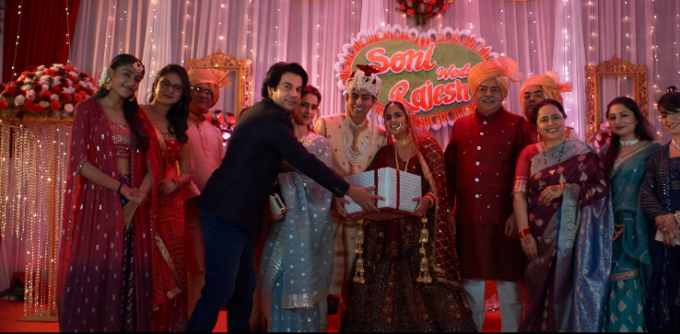
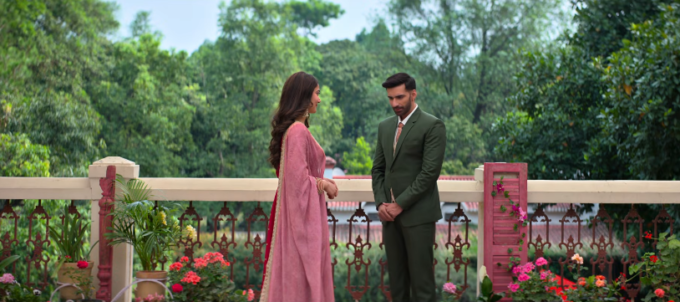
The “Love” chapter is the film’s strongest. It charts Paari’s encounter with Rukmini (Pooja Hegde) and the gradual blossoming of an organic, deeply felt romantic bond. The chapter builds with mounting excitement, climaxing in the film’s single greatest technical and artistic achievement: a breathtaking 15-minute unbroken single-shot sequence that incorporates action, drama, dance, and the celebratory wedding song “Kanimaa.” The sequence demands extraordinary coordination from cast, crew, and choreographers, and it delivers with a confidence that places it among the finest single-take achievements in recent Indian cinema.
Suriya’s face throughout this section — expressionless even amidst the joy around him — becomes both comic and deeply affecting. His inability to smile is rendered not as a quirk but as a wound, and the emotional payoff when his character finally allows himself joy is orchestrated with precision and patience.
Chapter Two — Laughter: Subbaraj Experiments, the Pace Adjusts
As the film moves into its “Laughter” chapter, Karthik Subbaraj deliberately shifts tone. The comedy, centred significantly on Jayaram’s character Dr. Chaplin, introduces a laughter therapy clinic — deliberately situated at the site of a former gallows, in a piece of irony Subbaraj pointedly calls “beautiful irony.” The chapter offers more backstory, fleshes out supporting characters, and deepens the audience’s understanding of Paari’s emotional geography.
This section divides viewers. The tonal modulation — from romantic sweep to comedy to exposition — is genuinely experimental, and not all of it lands. Jayaram’s performance veers into caricature at times, and the pacing, while never stagnant, does slow noticeably. However, the chapter fulfils a structural purpose: it accumulates detail, seeds mythology, and builds the scaffolding that the “War” chapter will subsequently demand.
Chapter Three — War: Subbaraj’s Most Outlandish Gamble
The film’s second half plunges into the most divisive territory of the three chapters. The “War” segment transports the narrative to an island-based conflict involving a violent cult, tribal lore, a Squid Game-adjacent colosseum-style combat system, and questions of Tamil identity and oppression that are simultaneously sincere and underdeveloped.
The Andaman Islands setting — strongly implied by critics to be a coded stand-in for Sri Lanka given Subbaraj’s political interests — frames an oppressed Tamil population seeking a saviour figure. Paari, via prophecy and lineage, is cast as that figure. The writing here is at its most ambitious and its most strained simultaneously. The mystery of the “Gold Fish” MacGuffin — the object Thilakan seeks throughout the film — is resolved in the climax, but by that point, the narrative has accumulated so many sub-plots, so many introduced-and-dropped characters, and so much mythological scaffolding that the resolution struggles to generate the emotional weight it demands.
Nevertheless, Subbaraj engineers a remarkable climax centred on laughter as a weapon — an entire community choosing collective joy as an act of resistance against authoritarian cruelty. It is a deeply unusual and genuinely original piece of storytelling, even if it arrives after the audience’s patience has been significantly tested.
Performances: Suriya Returns, and It Matters
Suriya as Paarivel Kannan
There is no ambiguity about Retro‘s greatest asset: Suriya delivers one of the finest performances of his career, and the film is worth watching for this reason alone.
The character of Paari asks Suriya to carry a 168-minute narrative almost entirely on expressional restraint. His face, deliberately blank for the film’s first half, must nonetheless communicate volumes — grief, longing, violence, love, and the slow thawing of a man who has taught himself not to feel. He succeeds with uncommon skill. The scenes where Paari’s guard momentarily drops are among the film’s most affecting, and the stunt sequences — with choreographer Kecha Khamphakdee designing action that suits Suriya’s physicality rather than demanding superhero physics — restore genuine credibility to his action star identity.
Multiple critics noted this explicitly: Rajasekar S of The Federal stated that Suriya stuns, while the Hindustan Times noted the film presents the Kollywood star in an action avatar with a streak of romanticism and sentiments. The Times of India credited Suriya’s swag as one of the key reasons audiences overlook the film’s indulgences. For a star whose recent output had disappointed, Retro emphatically re-establishes his position at the top tier of Tamil cinema.
Pooja Hegde as Rukmini
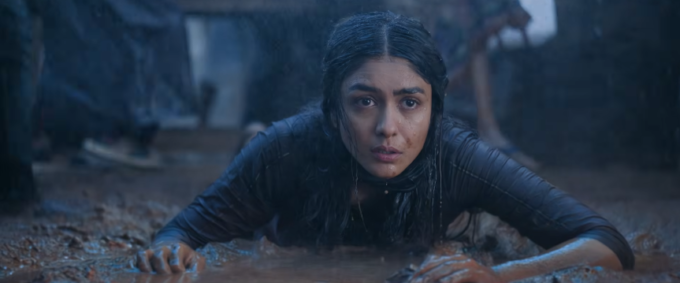
Pooja Hegde delivers the best Tamil performance of her career in Retro, a recognition that multiple critics across outlets have confirmed. She dubbed her own voice for the film — reportedly her first time doing so for a Tamil production — and brings an authentic emotional presence to Rukmini that elevates every scene she inhabits.
The Tamil Guardian called her performance outstanding, and Rajasekar S of The Federal described it as her career-best. Subbaraj writes Rukmini as a woman whose moral clarity and warmth function as Paari’s ethical anchor — and Hegde holds that weight convincingly throughout the first half. The film’s primary failing with her character is structural rather than performative: Rukmini is progressively sidelined in the second half, her narrative importance diminishing as the “War” chapter takes over. This is the screenplay’s flaw, not Hegde’s.
Joju George as Thilakan
Joju George brings considerable gravitas to Thilakan, the gangster foster father whose complex relationship with Paari forms the film’s emotional spine. His performance is cartoonish by design — the film’s visual grammar explicitly evokes vintage Tamil and East Asian genre cinema — and he navigates that register with skill, finding the genuine menace and occasional pathos beneath Thilakan’s theatrical villainy.
Supporting Ensemble: Mixed Results
The supporting cast is large and uneven in its effectiveness. Prakash Raj brings professional authority to his role, while Karunakaran provides reliable comic relief. However, the film’s most significant supporting performance issue is its villain, Vidhu as Michael Mirasu, who fails to project the menace the story requires at its most crucial dramatic junctures. Nasser’s island king characterisation swings too broadly into caricature to generate genuine threat, and Jayaram, despite the best intentions, is let down by material that does not fully develop his Dr. Chaplin into the resonant figure the film needs him to be.
Technical Excellence: Where Retro Unambiguously Succeeds
Cinematography — Shreyaas Krishna
Shreyaas Krishna’s cinematography is one of Retro‘s clearest achievements. The Andaman sequences are rendered with a lush, almost hyper-real visual richness that contrasts deliberately with the grittier palette of the mainland scenes. The long single-shot sequence around “Kanimaa” — managing action, choreography, lighting transitions, and emotional registers within an unbroken take — is a monument of technical planning and execution, earning this film a place in the conversation about the finest sustained single-shot sequences in contemporary Indian cinema.
The beach sequence at night, shot with extraordinary sensitivity to natural light and shadow, stands as another highlight in a film that frequently finds its visual confidence even when its narrative falters.
Music — Santhosh Narayanan
Retro marks Santhosh Narayanan’s eighth collaboration with Karthik Subbaraj and his first with Suriya — a milestone pairing that delivers exactly the kind of contextually intelligent score Subbaraj’s films have always demanded.
Kanimaa — The Song of the Year
“Kanimaa” is the undisputed centrepiece of the album and one of Tamil cinema’s most celebrated songs of 2025. Composed and sung by Santhosh Narayanan with The Indian Choral Ensemble, the song draws its rhythmic DNA from 1990s Tamil wedding folk traditions — what is known as “kalyana kuthu” — while adding the composer’s signature experimental texture. Lyricist Vivek’s words give the song its vernacular warmth.
The song’s hook step, choreographed by Sherif Master, went immediately viral upon release in March 2025, with celebrities across industries — including Terry Crews — posting recreations. The song peaked on the Billboard India Songs chart and the UK Asian Music Chart, confirming its cross-cultural reach. When experienced within the film’s context — as part of that extraordinary 15-minute single-shot sequence — it transcends the status of promotional single and becomes something structurally integral to the film’s emotional architecture.
The composition was influenced by T. Rajendar’s “En Aasai Mythiliye” from Mythili Ennai Kaathali (1986), a genealogy that perfectly encapsulates Subbaraj’s deliberate project of honouring the forms of old Tamil cinema within radically reconceived narrative frameworks.
The Broader Soundtrack
The first single “Kannadi Poove” — a tender love ballad released on Valentine’s Day 2025 — established the album’s emotional register. Pinkvilla described it as a mesmerising piece with vocals layered with tenderness that capture the essence of romance and longing. The third single “The One”, featuring Sid Sriram alongside Santhosh Narayanan and rapper SVDP, provides high-energy contrast, while “Love Detox” (performed by Suriya himself) brings a playful, self-aware quality to the mix.
Santhosh Narayanan’s background score is particularly effective in the first half, where it functions as an emotional amplifier for Suriya’s restrained facial performances. The second half’s score is less assured, reflecting the narrative’s own loss of coherent direction.
Editing — Shafique Mohamed Ali
Mohammed Shafique Ali, reuniting with Subbaraj after Jigarthanda Double X, handles a notoriously complex editing challenge: weaving together three tonally distinct chapters, multiple timelines, parallel flashbacks, and a mythological subtext into a coherent two-hour-forty-eight-minute experience. The first half’s edit is crisp and purposeful. The second half’s edit could have been more aggressive — several sub-plots and action sequences feel undercut by an unwillingness to sacrifice content that, while individually interesting, collectively undermines the film’s narrative momentum.
Thematic Depth: What Karthik Subbaraj Is Really Saying
Non-Violence as Radical Choice
At its core, Retro is a film about a man who chooses to abandon violence — and the world that refuses to let him. Paari’s journey from gangster enforcer to someone who actively protects rather than destroys is the film’s true subject, and Subbaraj frames this choice not as heroic simplicity but as a profoundly costly and often failing endeavour. The decision to arm his protagonist’s climactic resistance not with weapons but with collective laughter is the film’s most original gesture — an act of non-violent protest elevated to mythological status.
The Krishna Mythology — A Film Within a Story
As multiple critical analyses have noted, Retro embeds the Bhagavad Gita’s and Mahabharata’s narrative architecture within a Tamil gangster action film. Paari is born on Janmashtami, raised by a foster mother like Yashoda, separated from his true origins by a prophecy, and ultimately destined to liberate an oppressed people. The Andaman Island community’s suffering mirrors the political circumstances of any oppressed minority — and Subbaraj is sufficiently careful in his allegorical coding to ensure the political commentary operates without being reducible to a single reading.
Self-Referential Cinema — Subbaraj Revisiting His Own Filmography
Tamil Guardian’s extended analysis notes that Retro functions, in its climax, as a subversion of Karthik Subbaraj’s own ending to Jigarthanda DoubleX — making the film simultaneously a genre tribute and a self-critical revision. The Hollywood Reporter India observed that Subbaraj’s filmography-wide obsession with irony finds its most explicit expression here, including a laughter clinic built on the site of gallows — an image that crystallises the film’s tonal mission in a single architectural metaphor.
Comparison to Karthik Subbaraj’s Filmography
Understanding Retro requires some familiarity with Karthik Subbaraj’s broader body of work, which provides essential context for his ambitions here.
Jigarthanda (2014) and Jigarthanda DoubleX (2023) represent Subbaraj at his most disciplined and brilliant — films that subverted gangster genre conventions with meta-cinematic intelligence and sustained emotional clarity. Jagame Thandhiram (2021) was his first clear sign of the overreach that becomes more pronounced in Retro — an admirable political ambition that outpaced the film’s ability to contain it.
Retro sits between these poles. It is significantly more coherent and emotionally engaging than Jagame Thandhiram, and it contains sequences that rank among the very best of Subbaraj’s output — the Kanimaa single-shot sequence foremost among them. However, it does not match the formal discipline of either Jigarthanda film, and it falls into the same second-half trap that has characterized Subbaraj’s recent work: an inability to subordinate his many ideas to the demands of unified storytelling.
Critical Reception: What the Reviewers Said
Retro received generally positive reviews, with most critics acknowledging Suriya’s performance and Subbaraj’s ambition while noting the screenplay’s structural excesses.
The Tamil Guardian (4/5) offered the most enthusiastic assessment, calling Retro a mad experiment in which Subbaraj offers old wine in an almost unrecognisably new bottle, praising its cross-continental references from Quentin Tarantino to Bruce Lee to SP Muthuraman.
The Times of India (3/5) concluded that Karthik Subbaraj’s filmmaking flair, Suriya’s swag and Santhosh Narayanan’s foot-tapping songs make us overlook the indulgences of the second half and the misstep of the final 15 minutes.
The Hindustan Times (3/5) noted that the film follows the same blend of genres, stylish presentation and use of music as a narrative tool that Subbaraj has always deployed.
The Hollywood Reporter India praised Suriya’s earnestness and the film’s structural boldness, while acknowledging the villain and sub-plot introduced too late into the film as a significant structural weakness.
India Today (2/5) was sharper in its criticism, calling it Karthik’s overstuffed film that stumbles between eras and ideas — a verdict that reflects the genuine frustration the second half provokes in viewers who arrived with high expectations.
Is Retro Worth Watching? A Viewer’s Guide
For Suriya Fans
Absolutely, without reservation. Retro gives Suriya material commensurate with his talents, provides him a character arc with genuine depth, and delivers multiple scenes that will become fan classics. This is the comeback film his fanbase has wanted. The first half alone justifies the watch.
For Karthik Subbaraj Devotees
Yes, with adjusted expectations. If Jigarthanda DoubleX set an impossibly high bar, Retro should be understood as Subbaraj attempting something simultaneously simpler (a mainstream star vehicle) and more complex (mythological allegory embedded within a genre film). Not all of it works, but his obsessive vision is unmistakable and often thrilling.
For Fans of Tamil Masala Cinema
Yes. The film hits all the expected registers — romance, action, comedy, sentiment, spectacle — with confidence, even if it staggers in the second half. As a theatrical experience, particularly in EPIQ format, its scale is impressive.
For International Tamil Cinema Audiences via Netflix
Yes, with subtitles. The film’s mythological subtext and genre references reward deeper familiarity with Tamil cinema history, but the core emotional story of a man choosing love over violence is universally legible. The Kanimaa sequence alone is worth the watch.
For Casual Viewers Looking for a Tight, Efficient Thriller
With caution. At 168 minutes, Retro makes significant demands on attention and patience. Viewers who found Subbaraj’s earlier films difficult will find this one no easier, and arguably more indulgent in its second half.
Frequently Asked Questions About Retro (2025)
Where can I watch Retro (2025)?
Retro is available to stream on Netflix globally. It premiered on the platform on May 30, 2025, approximately four weeks after its theatrical release.
What does the title Retro mean?
The title is deliberately layered. At its most literal level, it refers to the film’s aesthetic project — a conscious invocation and reimagining of vintage Tamil and East Asian cinema forms. Thematically, it points to Paari’s journey backward into his origins, and cinematically, it signals Karthik Subbaraj’s most explicit homage to old-school Tamil cinema grammar.
What is the “Kanimaa” sequence?
“Kanimaa” is a 15-minute unbroken single-shot sequence in Retro that incorporates a wedding dance, action choreography, dramatic beats, and the song of the same name by Santhosh Narayanan. According to choreographer Sherif Master, it is the first time such a combination of action, drama, and dance has been executed within a single shot in Tamil cinema history. The song went massively viral on social media upon its March 2025 release.
Is Retro related to any previous Karthik Subbaraj film?
Retro is not a sequel or remake of any previous film. However, Karthik Subbaraj deliberately incorporates references and callbacks to his own earlier films — including Petta, Jagame Thandhiram, Mahaan, and Jigarthanda DoubleX — as part of its self-referential, meta-cinematic design.
What is the runtime of Retro?
Retro runs for 168 minutes, or 2 hours and 48 minutes, after receiving its U/A certificate from the CBFC.
Who composed the music for Retro?
The music was composed by Santhosh Narayanan, marking his first collaboration with Suriya and his eighth with Karthik Subbaraj. Audio rights were acquired by T-Series.
Did Retro perform well at the box office?
Box office reporting varied, with worldwide grosses estimated between ₹80 crore and ₹250 crore across sources. The film performed solidly in Tamil Nadu and with Tamil diaspora audiences, though fell short of some of the higher projections given Suriya’s star power. Its Netflix debut provided a significant second wave of viewership.
Review Overview
Summary
Retro is Karthik Subbaraj at his most simultaneously exhilarating and exasperating — a filmmaker of undeniable vision reaching further than his screenplay can cleanly sustain, carried across the finish line by a Suriya performance that demands serious reconsideration of where this actor stands in contemporary Tamil cinema. Its greatest achievement — the Kanimaa single-shot sequence — is a monumental piece of cinema that belongs among the medium's finest sustained technical and emotional achievements. Its deepest flaw — a second half that adds sub-plot upon sub-plot until narrative coherence buckles — is a genuine disappointment from a filmmaker who has demonstrated he can hold complexity in elegant balance. Nevertheless, Retro earns its place as one of the more important Tamil films of 2025. It marks Suriya's most impactful screen presence in years, Pooja Hegde's finest Tamil performance, and yet another demonstration that Karthik Subbaraj — even in his most indulgent mode — brings a quality of imagination to Tamil cinema that is rare and worth protecting. The first half is extraordinary. The second is flawed but never dull. On balance, Retro is absolutely worth your time — just go in knowing exactly what kind of filmmaker made it.
- Rating6.5











Leave a comment