



Released on January 23, 2026, by Amazon MGM Studios, Mercy is an American science fiction thriller directed by Timur Bekmambetov (Wanted, Night Watch) and written by Marco van Belle. The film stars Chris Pratt as a Los Angeles detective strapped to a chair, racing a 90-minute countdown to prove his innocence to an AI-powered judge — voiced and portrayed by Rebecca Ferguson — before the system sentences him to death.
The premise is genuinely provocative. In the near-future 2029 Los Angeles of Mercy, criminal courts have been replaced by the Mercy Capital Court — an AI-driven judicial system designed to bypass an overloaded, bureaucratic justice system and deliver swift verdicts. The defendant must bring his guilt probability below 92% within 90 minutes, using the city’s “Municipal Cloud” — a vast surveillance network of cameras, phones, drones, and databases — as his only investigative tool. No appeals. No jury. No second chances.
Mercy arrives at a moment when AI in law enforcement, predictive policing, and algorithmic sentencing are already active debates in the real world, giving the film immediate cultural relevance. Unfortunately, as this review explores in depth, the film possesses far more thematic potential than it successfully delivers. Critics scored it at just 24% on Rotten Tomatoes, while audiences responded more generously with an 83% user score — a split that itself tells you something important about what kind of film this is and who it is for.
Quick Facts: Mercy (2026) at a Glance
| Detail | Info |
|---|---|
| Director | Timur Bekmambetov |
| Screenplay | Marco van Belle |
| Stars | Chris Pratt, Rebecca Ferguson, Kali Reis, Annabelle Wallis, Chris Sullivan, Kylie Rogers |
| Studio / Distributor | Amazon MGM Studios |
| Runtime | 1 hour 39 minutes |
| Rating | PG-13 |
| Release Date | January 23, 2026 (theatrical); also released on Prime Video |
| Budget | $60 million |
| Worldwide Gross | $54.3 million |
| Score (Rotten Tomatoes) | 24% Critics / 83% Audience |
| Metacritic Score | Mixed |
| IMDb Rating | 6.1 / 10 |
The Plot: Everything You Need to Know
Setting the Scene: 2029 Los Angeles
Mercy opens in a near-future Los Angeles paralyzed by surging violent crime. In response, legislators have voted to activate the Mercy Capital Court — a fully automated judicial system in which an AI judge presides over trials for violent offenses, with the power to order execution upon a guilty verdict. All personal devices in the city are linked to a Municipal Cloud, giving the AI unrestricted access to surveillance footage, private communications, medical records, and financial data.
The Defendant: Detective Chris Raven
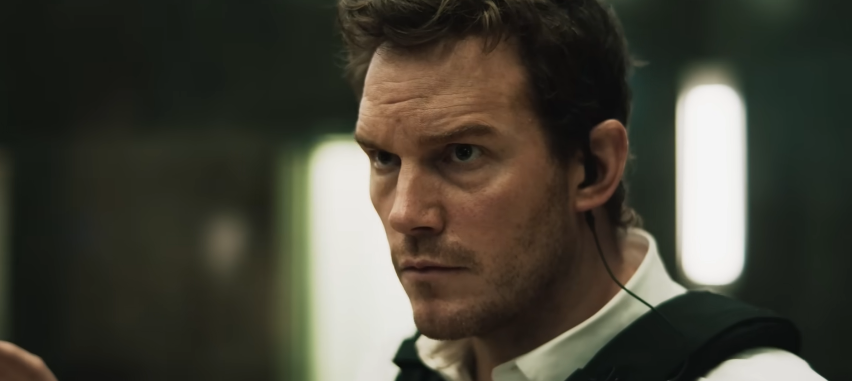
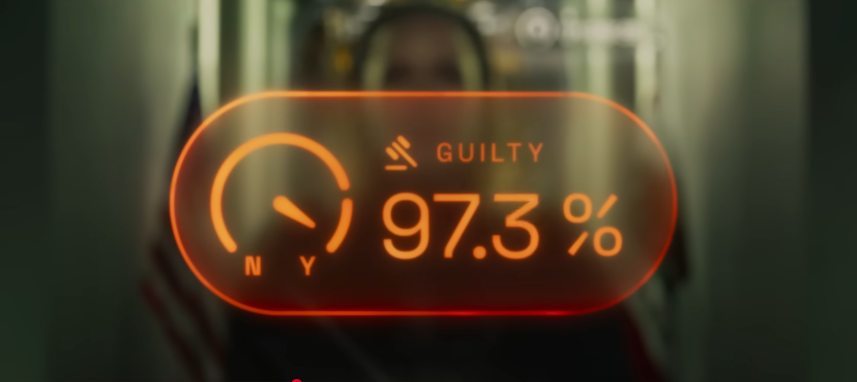
Los Angeles Police Department Detective Christopher “Chris” Raven (Chris Pratt), a strong proponent of the Mercy Court, is strapped to a chair and put on trial for his wife Nicole’s murder. He is given 90 minutes to persuade the AI judge of his innocence. Adding a layer of bitter irony, Raven was one of the architects of the very system now judging him. His guilt probability opens at 97.5% — an almost insurmountable number — and he must lower it below 92% to avoid execution.
Judge Maddox and the Rules of the Court
Presiding over his case is Judge Maddox (Rebecca Ferguson), an AI program who walks Chris through the court’s rules and then begins methodically processing evidence. The Mercy Chair sees defendants presumed guilty until they can prove their innocence under the 92% threshold. There are no appeals in this virtual court. Via Maddox’s unrestricted cloud access, Chris progressively uncovers a web of secrets: his wife Nicole was considering divorce, had been investigating missing chemicals at work, and had connections to individuals Chris barely recognized.
The Investigation and Twist
As Chris investigates through the Municipal Cloud’s surveillance systems, he traces a chain of suspects — from a chemist colleague to his own sobriety sponsor, Rob Nelson (Chris Sullivan) — ultimately discovering that a rogue cop named Jaq Diallo (Kali Reis), his own partner, deliberately manipulated the evidence to frame him. Jaq explains she wanted to ensure David was found guilty in the first AI court judgment to prove the system works. Both Jaq and Rob are taken into custody, and Chris’s case is formally dismissed.
The film’s third act explodes from courtroom procedure into full-scale action, providing a tension-release that the preceding 70 minutes of chair-bound drama has genuinely earned — even if its logic becomes increasingly strained.
The Screenlife Format: Mercy‘s Most Distinctive Quality
One of the most important things to understand about Mercy before watching it is that it belongs to a specific cinematic subgenre — screenlife filmmaking — and that its director, Timur Bekmambetov, is arguably the form’s most passionate champion in mainstream cinema.
What Is the Screenlife Format?
Screenlife films unfold primarily through the interfaces of digital technology — computer screens, phone cameras, drone footage, surveillance feeds, and social media platforms. Rather than conventional cinematography, the audience observes events through the digital devices characters inhabit. Films in this tradition include Unfriended (2014), Searching (2018), and Profile (2021) — the latter directed by Bekmambetov himself.
Bekmambetov is the godfather of the “screenlife” genre — the approach of telling stories entirely through screens, cameras, and digital interfaces. He produced Unfriended, Searching, and Missing, and as a director has taken some admirable swings with the format. With Mercy, he brings it to IMAX — the largest possible canvas for the most claustrophobic possible concept.
How Screenlife Works in Mercy
In Mercy, the format manifests as a relentless cascade of footage types: private cell phone clips, police drone footage, restaurant security cameras, neighbor bird cams, body cam recordings, and scrolling social media timelines. That static dynamic between Chris and Judge Maddox is countermanded with an endless barrage of images shot in varying styles, including private cell phone clips, police drone footage, visuals captured by restaurants, and street corner cameras.
This approach creates a genuinely unsettling atmosphere in the film’s opening act. The surveillance architecture does not feel like science fiction — it resembles tomorrow’s infrastructure described in today’s breathless tech marketing language. Every doorbell, every drone, every Ring camera feeds into a unified municipal cloud, and the screenplay raises legitimately disturbing questions about privacy in a world of social media, surveillance cameras, “citizen journalists” wielding smartphones, body cams, and so on.
Where the Format Succeeds and Where It Strains
The screenlife aesthetic genuinely works during Mercy‘s investigation sequences, particularly the crime scene walkthrough segments where Chris reviews footage in real time, piecing together his wife’s final hours. The ticking “Guilty Meter” — a numerical display of Chris’s probability of conviction — adds urgency and a visual shorthand for stakes that prove surprisingly effective throughout.
However, the format strains considerably in quieter dialogue scenes. Too much dialogue plays like a conversation with an automated phone service only marginally more animated than the one that fails to direct you to customer services. The film’s reliance on cutting repeatedly to Ferguson’s looming expression — the only “face” of Judge Maddox — becomes visually monotonous at a pace that would tax even patient viewers.
Mercy was a film trapped between two worlds — too expensive to be as profitable as more traditional screenlife films, and far too obsessed with computer and phone screens to become a must-see title for standard action cinema fans. This tension defines the film’s identity crisis at every level.
Performances: A Tale of Two Constraints
Chris Pratt as Detective Chris Raven
Chris Pratt carries the overwhelming majority of Mercy‘s screen time from a single chair, and the film’s success or failure rests significantly on whether he can sustain dramatic tension from that static position. The verdict from critics and audiences diverges sharply here.
Pratt can be a forceful and convincing actor with the right material, most notably the Guardians of the Galaxy series, but his physicality is a key component of his best performances. For the great majority of time here, Pratt is immobilized, and his emoting isn’t always entirely convincing.
That said, audience response has been notably warmer. Witnessing the genuine confusion, stress, and anger from Pratt was cited by some viewers as beautifully done — something that immersed them in the film and made them genuinely question whether his character might have committed the murder. The truth probably sits in between these positions: Pratt is committed and occasionally compelling, but the material does not consistently allow him to demonstrate the range the role genuinely requires.
His character’s ironic relationship with the Mercy system — having helped design it and now being condemned by it — is an intriguing dramatic setup that the script underexplores. The backstory elements, including Chris’s relapse into alcoholism following his partner’s death and the strain this placed on his marriage, add texture but are introduced too rapidly to generate genuine emotional investment.
Rebecca Ferguson as Judge Maddox
Rebecca Ferguson is the film’s standout — her portrayal of AI Judge Maddox is precise, unsettling, and genuinely original. Working within severe constraints — an emotionless AI character who cannot display conventional warmth or vulnerability — Ferguson delivers a performance of remarkable exactitude. Her vocal delivery is calibrated to suggest machine logic without fully abandoning the human qualities that make Maddox’s gradual development of something resembling “gut feeling” legible and interesting.
The film’s most philosophically intriguing thread — an AI judge beginning to operate outside the strict parameters of its programming — rests entirely on Ferguson’s ability to make those micro-shifts in behavior perceptible. She succeeds. The moments where Maddox bends her own rules to help Chris, drawn to something beyond pure data, represent Mercy at its most genuinely thought-provoking.
The tragedy is that the screenplay gives Ferguson so little to work with beyond reaction and procedure. She and Pratt share no physical space and no real scene-building — their interaction is fundamentally that of a user interfacing with a system, which is the point but also the limitation.
Supporting Cast
Kali Reis as Jaq Diallo delivers solid work in an underwritten role that asks her to function primarily as plot mechanism. Annabelle Wallis as the murdered Nicole appears almost exclusively in flashback and surveillance footage, a structural choice that makes her more MacGuffin than character. Chris Sullivan as Rob Nelson provides the film’s most textured supporting performance, portraying a man whose complicity emerges from desperation rather than malice.
Thematic Analysis: What Mercy Is Trying to Say
Despite its execution shortcomings, Mercy engages with genuinely important ideas — and understanding them helps contextualize why the film resonates with general audiences even as it frustrates critics.
AI and the Presumption of Guilt
The Mercy Court’s foundational premise — that defendants are presumed guilty until they can prove otherwise, within a 90-minute countdown, with no appeal process — is the film’s most provocative contribution to the ongoing cultural conversation about algorithmic justice. This inversion of the presumption of innocence that underpins most democratic legal systems is not merely dystopian fantasy.
Predictive policing algorithms, automated risk assessment tools, and AI-assisted sentencing systems already operate across multiple jurisdictions in the United States and elsewhere. Research from institutions such as ProPublica has documented significant bias issues in tools like COMPAS, which assigns risk scores to criminal defendants in ways that correlate with race. Mercy dramatizes a logical endpoint of these existing systems — and audiences respond because the premise does not fully feel like science fiction.
The Irony of the System’s Architect
Chris Raven helped build the Mercy Court. He championed AI justice because he believed it would be fairer, faster, and less susceptible to human corruption than traditional courts. The film’s central dramatic irony — that the system’s most fervent advocate becomes its most desperate prisoner — functions as a critique of technological solutionism: the tendency to believe that automating a problem eliminates the human failures embedded within it.
This theme has genuine resonance, though Mercy never fully commits to unpacking it. The screenplay gestures toward the idea that human bias, rather than AI malfunction, is what actually endangers Chris, but it does not follow this thread to a satisfying conclusion. Instead, the final beats retreat to a somewhat muddled message that AI makes mistakes but so do humans, and perhaps we should meet in the middle — a position that critics have fairly described as intellectually evasive.
Surveillance, Privacy, and the Municipal Cloud
The film’s surveillance architecture — in which every device in Los Angeles feeds into a unified cloud accessible to the court — raises pointed questions about the relationship between security infrastructure and civil liberties. Mercy uses this system simultaneously as plot convenience (giving Chris unlimited investigative reach) and as horror (making visible just how comprehensively ordinary life is already recorded). The effect is to make the audience feel surveilled by proxy — a legitimately effective piece of cinema, even if underdeveloped.
Mercy vs. Minority Report: An Unavoidable Comparison
Mercy has been compared to other police or science fiction thrillers with similar plot elements, notably Minority Report and The Fugitive, both featuring protagonists wrongfully connected to a mysterious murder, as well as RoboCop and its 2014 remake.
The Minority Report comparison is the most instructive and the most damaging. Steven Spielberg’s 2002 film — based on Philip K. Dick’s novella — occupies precisely the same thematic territory: a law enforcement system using technology to pre-determine guilt, and an insider who becomes its target. Where Minority Report succeeded was in its marriage of philosophical depth to visceral spectacle. The film interrogated its central premise with genuine intellectual rigor while delivering memorable action, iconic imagery, and a performance from Tom Cruise that activated his physicality to maximum effect.
Mercy hinges on the hope that the audience has either forgotten or never seen Minority Report — a far better, well-written, dystopian crime thriller that Mercy will never be.
This is perhaps the harshest and most accurate critical verdict the film has attracted. The comparison is not merely aesthetic — it is structural. Both films ask the same question: what happens when the system designed to protect us turns against us? Minority Report answers it with poetry. Mercy answers it with a thriller that frequently forgets to be thrilling.
That said, the comparison somewhat unfairly judges Mercy against one of the genre’s finest examples. Measured against more comparable genre entries — Eagle Eye (2008), Law Abiding Citizen (2009), or Upgrade (2018) — Mercy performs more respectably, delivering intermittent tension and a genuinely interesting formal experiment even if it ultimately underachieves.
Direction and Technical Craft: Bekmambetov’s Formal Ambition
Timur Bekmambetov is a director of genuine kinetic energy and formal ambition, as his earlier work — particularly Wanted (2008) and Night Watch (2004) — demonstrated with considerable flair. His commitment to the screenlife format represents a sustained artistic project, not merely a gimmick, and Mercy is the most expensive and technically ambitious iteration of that project yet.
The decision to release the film in IMAX is bold to the point of eccentricity. The screenlife format, by its nature, deals in small screens, intimate digital interfaces, and the claustrophobic experience of viewing the world through a phone camera. Expanding that aesthetic to the largest possible theatrical format creates a genuinely paradoxical viewing experience — intimate content presented at epic scale — that works better in theory than in practice.
The format is most effective when the film leans into its own absurdism — the guilty meter ticking down, the cascade of conflicting footage, the sense of a city being forensically autopsied in real time. When Bekmambetov trusts this absurdism, Mercy generates real momentum. The crime scene reconstruction sequences, in particular, showcase the format at its most inventive: Chris piecing together events through dozens of overlapping camera angles, each revealing a new fragment of the truth.
The visual effects work, blending grounded present-day technology with plausible near-future extrapolations, is accomplished. The world of 2029 Los Angeles feels like a logical extension of today rather than a fantasy projection, which grounds the film’s more outlandish legal premises in a recognizable reality.
Where Bekmambetov struggles is in the film’s quieter procedural passages. The director’s instinct for kinetic visual energy becomes a liability when the story requires stillness, patience, and the accumulation of dramatic tension through character rather than through editing rhythm.
Box Office Performance and Streaming Success
Mercy had a difficult theatrical run. The film opened to only $10.8 million domestically on a $60 million budget, ultimately grossing $54.3 million worldwide — a clear financial shortfall for a studio tentpole. The reasons for this underperformance are multiple and instructive.
January remains a challenging release window, typically populated by studio titles with limited theatrical ambitions. Mercy also faced the fundamental structural challenge that all screenlife films encounter in theatrical contexts: screenlife films have not surpassed $80 million worldwide, suggesting a firm ceiling for how lucrative such titles can be — and while Searching and Unfriended were made for pennies, Mercy cost $60 million.
The film’s recovery on streaming has been notable, however. After its addition to Prime Video, Mercy quickly rose to the number one spot on Prime Video’s global streaming charts — a trajectory that suggests the screenlife format genuinely translates better to home viewing than theatrical exhibition. Watching a film about surveillance infrastructure and digital evidence on a personal screen, with a phone in hand, provides a contextual immersion that no cinema can replicate. One reviewer noted that this viewing context “eliminates most of its shortcomings” — a backhanded compliment, but a genuine insight into how format and medium interact.
Critical Reception: Why the Audience-Critic Split Matters
The pronounced gap between Mercy‘s critical score (approximately 24-25% on Rotten Tomatoes) and its audience score (83%) deserves attention rather than dismissal. This gap does not simply mean that critics are out of touch with popular taste. It reflects a genuine difference in what these two groups prioritize.
Critics evaluating Mercy rightfully identified its screenplay’s logical inconsistencies, its undercooked thematic ambitions, its failure to fully develop its most interesting characters, and its derivative relationship to superior films covering the same territory. These are legitimate artistic criticisms.
Audiences responding to Mercy engaged primarily with its premise, its pacing, its tension mechanics, and the entertainment value of watching an irresistibly timely concept executed with professional competence. From this perspective, the film delivers what it promises: a propulsive, high-concept thriller that raises interesting questions even if it answers them poorly.
The film is amusing, occasionally clever, and perfectly serviceable as a distraction, but it never quite becomes the reinvention of the action film it seems to think it is. This Metacritic consensus captures the film’s position accurately — worth watching on its own terms, as long as those terms are clearly understood before you press play.
Should You Watch Mercy (2026)? A Viewer’s Guide
If You Enjoy High-Concept Genre Thrillers
Yes. Mercy delivers its premise with enough technical competence and formal inventiveness to satisfy genre fans willing to tolerate logical gaps. The core idea is strong, and the first half in particular generates genuine tension.
If You Are a Fan of Timur Bekmambetov’s Screenlife Work
Yes, with tempered expectations. The format is here in its most ambitious iteration yet. It is not as elegantly executed as Searching or as precisely crafted as Profile, but it represents an interesting step in the screenlife tradition’s evolution toward mainstream theatrical ambition.
If You Are Primarily a Chris Pratt Fan
Cautiously. Audiences who engage primarily with Pratt’s action persona — Star-Lord, Owen Grady, Mario — will find him constrained here. His performance is credible and occasionally moving, but the role asks for an entirely different skill set than his blockbuster work.
If You Are Interested in AI Ethics and Technology Themes
Yes, as a conversation starter. Mercy does not offer sophisticated analysis of AI in criminal justice, but it dramatizes the core anxieties around algorithmic authority in ways that are accessible and emotionally legible. Watch it alongside more rigorous explorations of the subject — documentaries, long-form journalism, or policy analysis — and it functions effectively as popular culture entry point.
If You Are Hoping for a Minority Report-Level Experience
Temper those expectations significantly. Mercy engages the same territory without the craft, the depth, or the cinematic ambition that made Minority Report a landmark. It is a capable but modest genre entry, not a genre-defining one.
Frequently Asked Questions About Mercy (2026)
Where can I watch Mercy (2026)?
Mercy is currently streaming on Prime Video as part of an Amazon MGM Studios subscription. It was originally released theatrically on January 23, 2026, and is also available for digital rental or purchase on platforms including Fandango at Home.
Is Mercy appropriate for all ages?
The film carries a PG-13 rating. It contains violence, mature themes surrounding murder and AI-driven capital punishment, and intense scenes of psychological pressure. It is not suitable for young children.
How long is Mercy (2026)?
The film runs 1 hour 39 minutes.
What is the Mercy Capital Court in the film?
The Mercy Capital Court is a fictional AI-powered judicial system in 2029 Los Angeles that tries defendants for violent crimes. The AI judge, powered by access to the city’s entire surveillance network, serves as judge, jury, and executioner. Defendants have 90 minutes to prove their guilt probability falls below 92% or face execution.
Who directed Mercy (2026)?
Mercy was directed by Timur Bekmambetov, the Russian-Kazakhstani filmmaker known for Wanted (2008), Night Watch (2004), and his work producing and directing films in the “screenlife” subgenre.
Did Mercy make money?
Mercy grossed $54.3 million worldwide against a $60 million budget, making it a modest box office shortfall. However, the film subsequently performed strongly on Prime Video, reaching the number one position on global streaming charts shortly after its digital release.
What is the Ramin Djawadi connection?
Ramin Djawadi, best known for composing the scores for Game of Thrones and Westworld, composed the score for Mercy. His work on the film provides atmospheric texture that the visuals alone do not always generate.
Final Verdict
Overall Rating: 5.5 / 10
Mercy is a film that arrives at exactly the right cultural moment with exactly the wrong screenplay. Its premise is urgent, timely, and cinematically potent — a near-future AI justice system, a ticking clock, a man accused by a machine he helped build. In more confident hands and with a more rigorously developed script, this could have been the definitive AI thriller of its era.
Instead, Mercy settles for being a competent genre exercise with ambitions larger than its execution. The screenlife format, employed with real technical ambition, generates genuine claustrophobia in its best sequences. Rebecca Ferguson delivers a performance that transcends the film’s limitations. The real-world resonance of AI-powered criminal justice lends the story weight that the writing alone could not sustain.
But the screenplay breaks its own rules for convenience, the thematic conclusions are muddled and intellectually evasive, and the character work is too thin to generate the emotional investment the film’s finale demands. The Minority Report comparisons are apt and lethal — not because Mercy is attempting to be that film, but because it is asking the same questions and coming back empty-handed.
As a streaming experience on Prime Video — where the screenlife format finds its most natural home, where the stakes of the premise feel immediate rather than distant, and where modest expectations can be modestly rewarded — Mercy is perfectly serviceable evening entertainment. It is not the film it could have been. But it is, just about, the film it needed to be to justify its existence.
Mercy Review Overview
Summary
A sleek, screen-driven thriller where Chris Pratt races against an AI judge to prove his innocence. Smart editing and strong performances elevate a contained premise.
The Pros
Innovative screen-life format, Chris Pratt & Rebecca Ferguson deliver, believable near-future tech, tight 90-minute runtime.The Cons
Limited visual variety, some predictable mystery beats, emotional depth takes a backseat to puzzle-solving.- Rating5.5












Leave a comment