


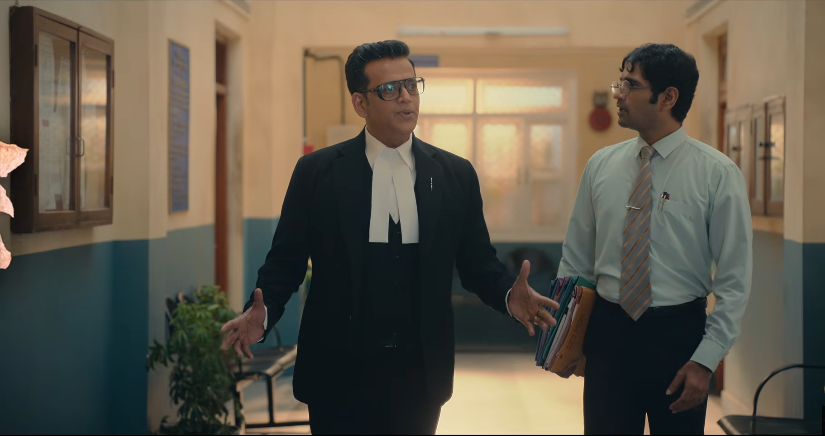
Order in the Court — Patparganj Is Back in Session
When Maamla Legal Hai arrived on Netflix in March 2024, it caught the Indian streaming landscape pleasantly off-guard. Here was a legal series that had absolutely no interest in being a legal series — no thundering courtroom orations, no weeping defendants, no slow-motion gavels. Instead, it offered something far rarer and considerably more honest: a workplace comedy set inside one of India’s most bureaucratically chaotic environments, where justice arrives not with a flourish but with the shrug of a man who is already late for his samosa break.
The show worked because it understood a fundamental truth about Indian institutional life — namely, that the distance between the lofty idealism of a system and the messy humanity of its participants is not a tragedy to be dramatised but a comedy to be savoured. Ravi Kishan’s advocate Visheshwar Dayal Tyagi, better known as V.D. Tyagi, became one of the year’s most unexpectedly beloved small-screen characters: a morally flexible, socially irresistible fixer of chaos who somehow also managed to be endearing.
Season 2, which dropped all eight episodes simultaneously on Netflix on April 3, 2026, arrives with the considerable pressure of a proven hit behind it. The first season spent two weeks in Netflix’s Global Top 10 Non-English Series and four weeks in the Top 10 in India, Pakistan, and Bangladesh. It was renewed for a second season as early as April 4, 2024 — just days after its premiere — suggesting the platform’s confidence in its sustained appeal. The question Season 2 must answer is not whether Maamla Legal Hai can maintain its core charm but whether it can evolve beyond it.
The answer, appropriately enough for a show about an imperfect system, is: mostly yes, occasionally not, and almost always watchably.
Streaming Platform: Netflix
Release Date: April 3, 2026
Episodes: 8 (all released simultaneously)
Episode Runtime: Approx. 35–38 minutes each
Rating: TV-MA (U.S.); for mature audiences
Language: Hindi (subtitled in 35 languages; dubbed in English, Tamil, and Telugu)
Creators: Sameer Saxena, Saurabh Khanna, Kunal Aneja
Director: Rahul Pandey
Writers: Kunal Aneja, Syed Shadan, Mohak Aneja, Mukund Narayan
Production Banner: Posham Pa Pictures
Cast: Ravi Kishan, Nidhi Bisht, Anjum Batra, Naila Grrewal, Anant V. Joshi, Kusha Kapila, Dibyendu Bhattacharya, Dinesh Lal Yadav (Nirahua), Vikram Pratap, Amit Vikram Pandey, Vijay Rajoria, Tanvi Azmi, Vijayant Kohli
Our Rating: ★★★½ / 5
Season 2 Premise: V.D. Tyagi Becomes a Judge and Discovers That Power Is a Trap

Season 2 picks up directly from where Season 1 concluded. V.D. Tyagi has been elevated from advocate to Principal District Judge at Patparganj District Court, Delhi — a promotion that represents both a professional triumph and an existential complication. On one side, he gets the robe, the chamber, the deference, and the fantasy of finally making a real difference. On the other, he loses the thing that made him good at his job and good at navigating people: the freedom to be himself.
The season’s central dramatic engine is Tyagi’s gradual disillusionment with the judicial role. He arrives with grand visions — of introducing sweeping policies, of modernising procedures, of being the judge he always wished he’d appeared before. Reality, as the show systematically demonstrates, is less cooperative. He discovers that even a polite smile in a courthouse corridor can generate allegations of bias. He discovers that his capacity to “care” — the Munna Bhai M.B.B.S.-ish interpersonal warmth that distinguished him as a lawyer — actively undermines his authority as a judge. He discovers that the black-and-white rules of the law sit uncomfortably with the grey moral instincts that made him effective.
Meanwhile, the lawyers of Patparganj continue their own orbits. Sujata Negi (Nidhi Bisht) has graduated from the foyer to a proper chamber, which she must now share with Mintu (Anjum Batra) — a cohabitation that generates predictably excellent conflict. Ananya Shroff (Naila Grrewal), the Harvard-returned idealist, gets a romantic subplot and faces competition from a new arrival. Court manager Vishwas Pandey (Anant V. Joshi) continues to hold the show’s emotional center with his quiet resilience. And Kailash Shubhkela (Dibyendu Bhattacharya), a newly appointed fellow district judge, becomes Tyagi’s unlikely confidant and, by the climax, the source of the season’s most testing moral question.
New additions include Kusha Kapila as Naina Arora, a sharp, elite-Delhi lawyer who becomes Ananya’s professional rival and comedic foil, and Dinesh Lal Yadav (Nirahua) in a supporting role that has been widely praised for its comic timing and authenticity.
Episode Guide: What to Expect From Each Episode
Season 2 maintains the same case-per-episode format that distinguished Season 1, drawing each storyline from real-life newspaper headlines — as the show’s disclaimer proudly announces, it is “satya durghatnaon par aadharit” (based on true incidents). Here is a brief, spoiler-light breakdown of what each episode covers:
Episode 1 — “Without Fear or Favour” A mishap during Tyagi’s oath ceremony creates immediate bureaucratic chaos. Ananya faces a product liability case involving a deodorant company and armpit burns.
Episode 2 — “Unbiased” Tyagi’s first official day as judge takes an awkward turn that tests the boundaries between friendship and judicial propriety. Ananya and Sujata join forces to defend a colleague in an unusual internal dispute.
Episode 3 — “Balanced” Tyagi introduces a new courtroom procedural rule that generates far more resentment than progress. Sujata handles a peculiar consumer complaint that doubles as a meditation on institutional absurdity.
Episode 4 — “Emotional Attachment” One of the season’s more poignant episodes involves a case touching on organ donation and the bureaucratic indifference surrounding it. Tyagi navigates a conflict between personal loyalties and judicial impartiality.
Episode 5 — “Reasonable Doubt” Naina Arora (Kusha Kapila) formally enters the fray, creating an elite rivalry with Ananya. The episode plays the culture clash between South Delhi legal chic and Patparganj’s unglamorous reality for maximum comic effect.
Episode 6 — “Material Evidence” The cannabis-addicted rats episode — already widely circulated as the season’s standout absurdist set piece — arrives here. A judge examining evidence in a room decorated by a blood-splattered Lady Justice statue is peak Maamla Legal Hai.
Episode 7 — “Character Witness” The season’s most tonally ambitious episode attempts to balance a case touching on gay rights and property law with the show’s predominantly light register. The results are uneven but earnest.
Episode 8 — “Beyond Reform” The season finale tightens the screws on Tyagi’s relationship with Kailash, delivering a climactic twist that some critics found contrived and others found earned. Ananya makes a risky professional move, and Sujata confronts a personal mistake.
Performances: The Ensemble That Makes Patparganj Feel Real

Ravi Kishan as V.D. Tyagi
Ravi Kishan remains the indisputable heart of the series, and his performance this season is simultaneously his most constrained and his most interesting. As Tyagi the judge, Kishan must play a man who is suppressing the very qualities that made him magnetic — the easy sociability, the tactical bending of protocol, the cheerful manipulation. The result is a performance full of meaningful silences and careful calibrations. Bollywood Hungama described him as “exemplary” and noted that he “totally gets into the skin of his character.” India TV News observed that even in silence, “when he simply stares at a lawyer, the moment carries weight.”
The criticism that Season 2 Tyagi is “stiffer” than Season 1 Tyagi is technically accurate, but it misses the point: the stiffness is intentional. Tyagi is a man performing the gravity his new role demands while his natural instincts chafe against the performance. Kishan communicates that internal friction with precision. The moments when the performance cracks — when Tyagi allows himself a flash of his old warmth at an inopportune moment — are the season’s most human.
Nidhi Bisht as Sujata Negi
Nidhi Bisht continues to function as the show’s moral and comedic spine. Sujata’s arc this season — the tug-of-war over chamber naming rights with Mintu, the ongoing negotiation between professional ambition and personal integrity — gives Bisht substantial material, and she delivers with characteristic precision. Bollywood Hungama noted that she “is the soul of the show,” and Outlook India’s review observed that “her quest for a chamber of her own continues this season, in line with gaining more conviction and confidence.” Bisht’s comic timing remains impeccable, and her occasional moments of unexpected warmth give the character dimensions that purely farcical writing would have collapsed.
Naila Grrewal as Ananya Shroff
Ananya Shroff remains one of the show’s most productively complicated characters — an idealist who has been forced to develop enough pragmatism to survive, but not enough to abandon her principles. Naila Grrewal handles this ongoing tension with a confidence that has grown notably since Season 1. The romantic subplot involving Ananya and Law (Amit Vikram Pandey) gives her character emotional stakes beyond the purely professional, and Grrewal rises to the material with sincerity. Her rivalry with Naina Arora (Kusha Kapila) generates some of the season’s sharpest comedic exchanges.
Kusha Kapila as Naina Arora
Kusha Kapila’s arrival as Naina Arora — a polished, elite, hyper-competitive lawyer from a different professional universe than Patparganj’s habitual chaos — is the season’s most anticipated new casting, and the verdict is warmly mixed. Kapila carries the role with natural confidence, and her comic timing integrates well into the ensemble’s rhythm. The criticism, shared by multiple reviewers, is that the writing undersells her. India TV News noted that “the writing does not give her character enough depth.” Leisurebyte’s review observed that she “almost plays herself.” Nevertheless, her screen presence elevates every scene she inhabits, and the rivalry with Grrewal’s Ananya is consistently the season’s most energetic dynamic.
Anant V. Joshi as Vishwas Pandey
Of all the characters in Maamla Legal Hai, Vishwas Pandey remains the one whose emotional quiet most rewards careful attention. Anant Joshi plays him with a specificity that never overreaches — a man whose loyalty to the institution and whose personal modesty combine to make him the show’s most grounded presence. His sub-plot involving a blossoming friendship and a simultaneously complicated romantic situation gives Joshi more material than Season 1, and he uses every moment. The Hollywood Reporter India’s original review specifically praised Joshi’s energy as “the one guy who doesn’t have the luxury of a tangible payoff.”
Dibyendu Bhattacharya and Dinesh Lal Yadav (Nirahua)
Dibyendu Bhattacharya’s Kailash is the season’s most layered supporting addition — a fellow district judge whose bond with Tyagi functions as both emotional counterweight and narrative accelerant. The Week’s review noted that Bhattacharya “brings the right degree of seriousness to a slippery, layered role.” Dinesh Lal Yadav, Bhojpuri cinema’s beloved Nirahua, makes a memorable impression in his supporting role, with Bollywood Hungama noting that he “is hilarious and it needs solid conviction to pull off such a character.”
What Season 2 Does Better Than Season 1

Season 2 addresses the most consistent criticism of its predecessor directly and meaningfully. The first season’s primary weakness was a lack of trust in its own genre identity — it occasionally second-guessed its sitcom credentials and overreached toward something more dramatically substantial than its low-stakes tone could sustain. Season 2 does not make this mistake. It settles into the Patparganj ecosystem with the confidence of a show that has earned its audience’s goodwill and is prepared to use it.
Several specific improvements stand out. The world-building is notably richer — the Patparganj District Court feels genuinely lived-in, with the kinds of micro-relationships and running institutional jokes that reward viewers who have followed the series from the beginning. The character work is deeper: Sujata, Ananya, and Vishwas all receive arcs that develop meaningfully across the season rather than resetting after each episode. The cases themselves are more imaginatively diverse, ranging from the purely absurdist (cannabis-addicted rats; deodorant-related skin damage) to the genuinely socially weighted (a case touching on gay rights and property law; a sexual harassment reversal that the show navigates with more complexity than similar content in Season 1).
Outlook India praised the show’s ability to weave “commentary into its wit so seamlessly that the underlying message remains present, yet never over-emphasised.” That balance — between entertainment and sociopolitical insight — is sharper in Season 2 than it was in Season 1.
Where Season 2 Falls Short
Honesty demands acknowledging the weaknesses alongside the strengths. The most common critical observation — that Season 2 is less funny than Season 1 — is broadly accurate, though it requires context. The comedy this season is more diffuse: it arises from character and situation rather than from the high-density gag construction that made Season 1’s best episodes so energetically entertaining. Whether this represents growth or dilution will depend on individual viewer preference.
The cartoonish sound design remains a persistent issue. The exaggerated audio cues that accompany comic moments continue to undercut the show’s satirical intelligence by signalling jokes before the audience has the opportunity to arrive at them independently. This is a consistent creative choice rather than an oversight, which is precisely what makes it frustrating.
Kusha Kapila’s Naina Arora is underwritten in ways that the character’s prominence in the marketing made more conspicuous. The climactic twist involving Tyagi and Kailash divides critics — India TV News found it “contrived,” while other reviewers found it emotionally satisfying. The cases that touch on weightier social themes — particularly the sexual harassment reversal and the gay rights property dispute — occasionally strain against the show’s fundamentally light register without quite achieving the tonal sophistication required to handle them fully.
The Satire at the Centre: What Maamla Legal Hai Is Really About

It would be a mistake to engage with Maamla Legal Hai purely as comedy without acknowledging the satirical argument running underneath it. The show’s premise — that a district court populated by well-meaning, fundamentally ordinary, frequently foolish human beings is the frontline of Indian democracy’s delivery of justice — is not a comfortable one. Every absurd case, every procedural farce, every pen-wrestling contest between judges is a specific and pointed observation about the gap between what India’s legal institutions promise and what they actually provide.
The show’s opening narration, delivered by Vijay Raaz, frames the series as based on “satya durghatnaon” — true accidents or incidents. The phrase carries a double meaning that the show consistently exploits: these situations are both literally true (inspired by newspaper headlines) and metaphorically accidental — the unintended consequences of a system that was designed with noble intentions but operates in an environment of resource constraints, bureaucratic inertia, human limitation, and institutional inertia.
Ravi Kishan’s Season 2 arc captures this tension with particular clarity. Tyagi’s disillusionment as a judge is not the story of a corrupt man or an indifferent system. It is the story of a decent, intelligent, well-intentioned person discovering that structural constraints limit the impact of individual virtue. That is a more honest and more uncomfortable conclusion than most Indian legal dramas are willing to reach, and Maamla Legal Hai delivers it wrapped in jokes about cats-fishing lawyers and monkey repellers.
Critical Consensus: What Other Critics Are Saying
The critical response to Season 2 has settled into a broadly positive register, with near-universal praise for Ravi Kishan’s performance and the ensemble’s chemistry, tempered by acknowledgment that the season does not quite reach the comedic heights of its predecessor.
Outlook India praised the show’s balance of sociopolitical commentary and entertainment, specifically highlighting Nidhi Bisht as “hilarious yet heartwarming.” Bollywood Hungama called Ravi Kishan “exemplary” and singled out Kusha Kapila as leaving “a huge mark” despite limited screen time. Leisurebyte’s review called it “one of Netflix’s best Hindi series,” noting its capacity to “present society’s issues to its viewers with warmth and humour.” The Week offered a positive verdict, noting that the season “deepens its characters, adding layers, and making them feel more rooted.” Scroll.in was more measured, observing that the show “maintains its predecessor’s frivolity even as it tries to live up to the solemnity of Tyagi’s new position” and that “the show’s heart beats faster for tomfoolery.” India TV News offered the season’s most sceptical mainstream verdict, calling it “an out-of-court settlement” that “works, it satisfies to an extent, but it doesn’t stay with you.”
The IMDB score for the series stands at 8.3 out of 10 — a strong audience endorsement that has held through the Season 2 premiere. Caleidoscope notes that the show holds an 83% audience and critics score on Rotten Tomatoes.
Season 1 vs. Season 2: A Quick Comparison
For viewers deciding whether to start with Season 1 or jump straight into Season 2, here is a clear comparison of the two seasons across the dimensions that matter most.
Comedy Density: Season 1 delivers more laughs per episode through tighter gag construction. Season 2 distributes its humour more evenly but with less concentrated impact.
Character Depth: Season 2 substantially outperforms Season 1 in character development, particularly for Sujata, Ananya, Vishwas, and the new addition of Kailash.
Case Quality: Both seasons draw from real-life incidents with equal ingenuity. Season 2’s cases range slightly wider thematically, incorporating heavier social material.
Thematic Ambition: Season 2 is more deliberately interested in the institutional critique beneath the comedy, which makes it more intellectually satisfying and occasionally less purely fun.
New Cast Contributions: Kusha Kapila and Dinesh Lal Yadav enrich the ensemble, even if Kapila’s character is underwritten relative to her potential.
Recommendation: Watch Season 1 first. It provides essential character context and represents the series at its most immediately entertaining. Season 2 rewards viewers who arrive with that foundation.
Frequently Asked Questions About Maamla Legal Hai Season 2

Do I need to watch Season 1 before Season 2? Strongly recommended, yes. Season 2 builds directly on Season 1’s character relationships, the promotion of Tyagi, and the ensemble dynamics established across the first eight episodes. While newcomers can follow the broad story, long-running jokes and character arcs will carry significantly more weight for returning viewers.
How many episodes does Season 2 have? Season 2 has eight episodes, each running approximately 35–38 minutes. All eight episodes were released simultaneously on Netflix on April 3, 2026, making it easily bingeable in one sitting.
Is Season 2 available in languages other than Hindi? Yes. Maamla Legal Hai Season 2 is available in Hindi with subtitles in 35 languages, and with dubbed audio in English, Tamil, and Telugu on Netflix.
Is the show appropriate for all ages? The series carries a TV-MA rating in the United States for language and adult themes. Parental guidance is recommended, particularly for younger teens, as several episodes touch on sexual harassment, homophobia, and the death penalty — even if handled with the show’s characteristic lightness.
When is Season 3 likely? No official announcement has been made regarding a third season. Given the first season’s rapid renewal (within four days of its premiere) and Season 2’s broadly positive audience reception, a third season is a reasonable expectation, though no confirmed timeline exists.
Who created the show? Maamla Legal Hai was created by Sameer Saxena (also known for Netflix India’s Kaala Paani and Jaadugar), Saurabh Khanna, and Kunal Aneja, and is produced by Posham Pa Pictures.
Is the show based on real cases? Yes. Each episode draws from real Indian newspaper headlines, which the show explicitly acknowledges through its “satya durghatnaon par aadharit” (based on true incidents) disclaimer, delivered by Vijay Raaz at the opening.
Verdict: A Confident, Warmer, and Slightly Less Funny Sequel That Earns Its Place

Maamla Legal Hai Season 2 is not the season that will convert sceptics who found Season 1 too slight or too silly. It maintains the same tonal register, the same case-per-episode format, the same commitment to finding laughs in the rubble of Indian institutional life, and many of the same creative habits — including the cartoonish sound cues that the show’s most passionate admirers have learned to accept as a feature rather than a bug.
What it adds, however, is meaningful: richer character work, deeper world-building, more deliberate satirical intent, and the fascinating dramatic engine of watching a man discover that promotion is not always liberation. Ravi Kishan delivers his most nuanced performance in the role, and the ensemble — anchored by Nidhi Bisht’s magnificent Sujata and Anant Joshi’s quietly compelling Vishwas — continues to function as one of Hindi streaming’s most genuinely warm and reliably funny groups of performers.
If Season 1 established Maamla Legal Hai as a pleasant surprise, Season 2 establishes it as a series with genuine depth beneath its comic surface. That is a more modest achievement than a laugh-per-minute comparison might suggest, but it is a more durable one. Patparganj District Court is, it turns out, a place worth returning to — not because everything works but because the people who work there, and the chaotic system they navigate, feel increasingly real.
Maamla Legal Hai Season 2 is available now on Netflix worldwide.
Review Overview
- Rating7














Leave a comment