



Released on August 5, 2022, exclusively on Apple TV+, Luck is a feature-length animated fantasy-comedy produced by Skydance Animation. Directed by Peggy Holmes and produced under the oversight of former Pixar chief John Lasseter, the film stars Eva Noblezada, Simon Pegg, Jane Fonda, and Whoopi Goldberg in a story about the world’s unluckiest person stumbling into the magical Land of Luck.
The film carries considerable weight beyond its whimsical premise. It marks the debut feature of Skydance Animation, a studio that has ambitiously positioned itself as a genuine alternative to Pixar, DreamWorks, and Disney. It also signals John Lasseter’s return to animation following his controversial departure from Disney/Pixar in 2017 — a context that shaped critical discourse around the film as much as its artistic merits.
After years of development, multiple director changes, and a studio partnership shift from Paramount to Apple, Luck finally landed on screens to a mixed critical reception. On Rotten Tomatoes, it hovered around a 48% Tomatometer score at launch, with a Metacritic score of 51, placing it squarely in the “divisive” category.
So, does Luck deserve a fairer hearing? Or does it confirm its critics’ harshest verdicts? This comprehensive review examines the film from every angle — story, animation, themes, voice performances, and its broader significance for streaming animation.
Quick Facts: Luck (2022) at a Glance
| Detail | Info |
|---|---|
| Director | Peggy Holmes |
| Screenplay | Kiel Murray (story by Jonathan Aibel & Glenn Berger) |
| Producer | John Lasseter, David Ellison, Dana Goldberg |
| Voice Cast | Eva Noblezada, Simon Pegg, Jane Fonda, Whoopi Goldberg, Flula Borg, Lil Rel Howery |
| Studio | Skydance Animation |
| Distributor | Apple Original Films (Apple TV+) |
| Runtime | 1 hour 45 minutes |
| Rating | G |
| Release Date | August 5, 2022 |
| Music | John Debney |
The Plot: What Luck Is About
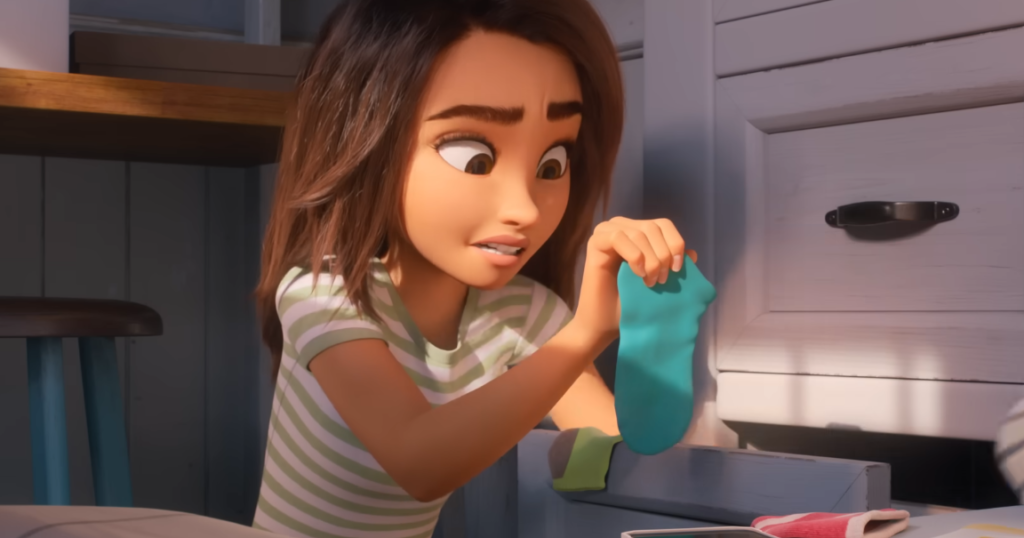
The film centers on Sam Greenfield (voiced by Eva Noblezada), an 18-year-old who has just aged out of the Summerland Home for Girls — an orphanage where she spent her entire childhood without ever being adopted. Sam is not bitter about this, however. She remains relentlessly cheerful and kind, obsessively devoted to ensuring that her younger orphanage friend Hazel (Adelynn Spoon) secures a loving family. Hazel believes in lucky charms, and Sam’s one goal is to find her a lucky penny.
Sam herself is chronically cursed. Toast lands jelly-side down. Bathroom brooms trap her unexpectedly. A new job at a craft store devolves into glitter-and-cactus catastrophes. The film establishes her bad luck through a rapid-fire series of slapstick sequences, clearly drawing inspiration from the physical comedy traditions of Buster Keaton, Lucille Ball, and Charlie Chaplin — an intentional choice by the filmmakers during production research.
Everything changes when a sleek black cat named Bob (Simon Pegg, in a thick Scottish brogue) accidentally leads Sam through a portal to the Land of Luck — a secret dimension where magical creatures manufacture good luck tokens and distribute them to humans worldwide. This elaborate “luck factory” operates like a fantastical industrial complex: leprechauns process luck crystals, a pink dragon (Jane Fonda) serves as a wise elder, a unicorn named Gerry (Flula Borg) adds comic flair, and a gruff Captain (Whoopi Goldberg) oversees the whole operation.
Crucially, humans are strictly forbidden in the Land of Luck. Sam must conceal her identity while racing to acquire a lucky penny for Hazel and eventually confronting the deeper source of her seemingly endless misfortune.
Animation Quality: Where Luck Genuinely Shines
Before addressing Luck‘s more debated elements, it is worth acknowledging where the film clearly succeeds: the animation itself is often stunning.
Skydance Animation — working across studios in Los Angeles, Connecticut, and Madrid (formerly Ilion Animation Studios) — delivers visually impressive work. The Land of Luck is rendered with imaginative detail, featuring crystalline luck tokens, luminous color palettes, and inventive creature designs. The bioluminescent architecture of the luck dimension, while not wholly original, demonstrates the technical capability of a studio still building its pipeline.
The bunny rabbits that populate the Land of Luck — wearing tiny hazmat suits to collect bad luck crystals — are consistently the most charming characters on screen. Multiple critics noted that these supporting creatures had genuine comedic timing and visual wit, pointing toward what Skydance’s animation team is capable of when given room to breathe.
Where the animation becomes inconsistent is in character design for the principal cast. Sam’s design, in particular, has been described as overly rubbery and stiff by several reviewers, lacking the nuanced expressiveness that Pixar’s character animation typically achieves. The comparison to Pixar is inevitable and, unfortunately for Luck, almost always unfavorable.
Story and Screenplay: The Film’s Achilles’ Heel
If the animation represents Luck‘s ceiling, the screenplay represents its floor — and the gap between the two is where the film’s greatest problems lie.
An Overloaded World-Building Problem
The film’s most significant structural flaw is its relentless commitment to exposition. The Land of Luck operates according to rules so elaborate and convoluted that the film devotes scene after scene to explaining them. Characters frequently pause the story to outline how luck crystals are made, sorted, assigned, and distributed — a process that audiences must track in real-time without adequate narrative scaffolding.
As The Spool observed, the film “overwhelms its young audience with too much expository dialogue” when “adolescents want wonder and soaring emotion, not endless chatter about how a fictional world operates.” This is a foundational mistake that undermines Luck‘s central ambition: creating a richly imagined alternate world that feels lived-in and believable.
Compare this to Monsters, Inc. — the film Luck most clearly wants to emulate. That Pixar classic introduced its monster workplace through character behavior and visual storytelling, not verbal explanation. Viewers absorbed the rules of Monstropolis organically. Luck instead hands the audience a user manual.
A Villain-Shaped Hole
A second major weakness is the complete absence of a compelling antagonist. Sam and Bob face obstacles, but no character meaningfully opposes them with intelligence or menace. The film’s dramatic tension relies almost entirely on bad luck itself as an abstract force — an insufficient substitute for a well-designed villain who could drive the stakes higher and give the protagonists something to genuinely overcome.
This absence creates a structural flatness. Without an antagonist, the third act lacks the escalating confrontation that animated family films typically require to generate emotional payoff. When the climax arrives, it feels engineered rather than earned.
The Repetitive Bad Luck Gag
The film establishes Sam’s chronic misfortune in the opening act through a succession of slapstick mishaps. However, rather than building and evolving these gags into more complex comic set pieces, the screenplay simply repeats the same basic template throughout — something drops, something spills, Sam perseveres. The comedic escalation that might have given these moments freshness never materializes.
What the Script Gets Right
That said, the screenplay does contain genuine ideas worth acknowledging. The film’s underlying message — that bad luck is not a personal failing, and that resilience and generosity matter more than fortune — carries real weight for young audiences, particularly those who, like Sam, feel that life has not dealt them a fair hand. The orphan narrative, informed by interviews the filmmakers conducted with real foster care youth, grounds Sam’s motivation in authentic emotional truth.
Additionally, the relationship between Sam and Bob develops with genuine warmth. Bob’s eventual declaration that Sam’s goodness and selflessness are more remarkable than any lucky penny represents the film’s emotional high point, and Simon Pegg delivers it with understated sincerity.
Voice Performances: A Talented Cast Unevenly Utilized
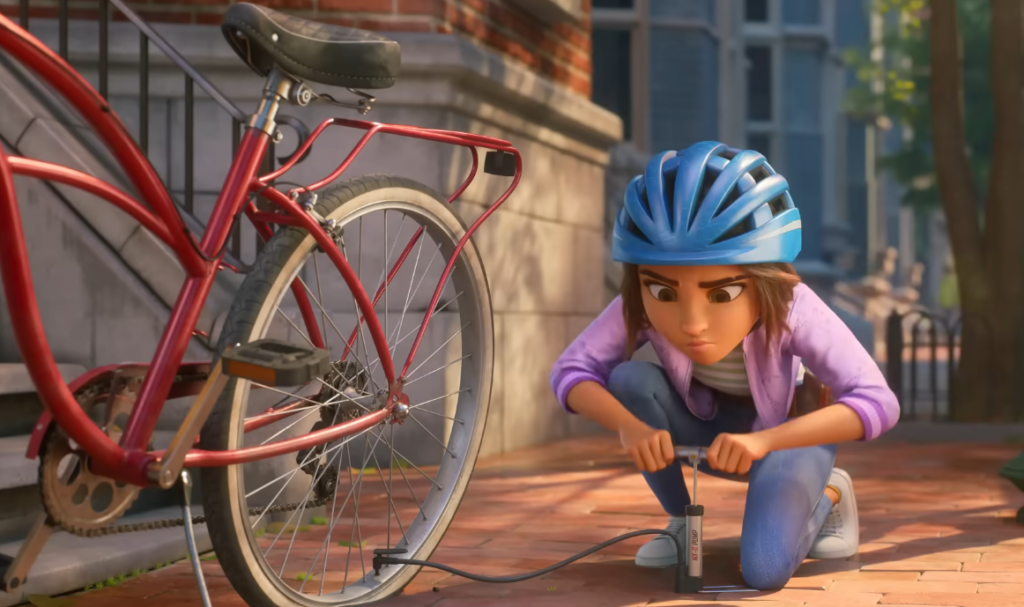
The voice cast assembled for Luck is legitimately impressive, and several performances rise above the material.
Eva Noblezada brings warmth and sincerity to Sam without tipping into saccharine territory. Her natural charisma keeps the lead character likable even when the script gives her little to do beyond reacting to misfortune.
Simon Pegg is the film’s standout performer. His Scottish-accented Bob crackles with dry wit, and his chemistry with Noblezada gives their partnership a genuine dynamic. Pegg, known for films like the Mission: Impossible franchise, brings a sly comic timing that elevates every scene he inhabits.
Jane Fonda as the pink dragon provides dignified warmth, while Flula Borg’s German unicorn generates consistent laughs through sheer absurdist commitment. Lil Rel Howery makes the most of limited screen time as Sam’s flustered boss.
The one performance that several critics found underwhelming is Whoopi Goldberg as the Captain. A character conceived as authoritative and imposing, the Captain’s execution feels curiously flat — a missed opportunity given Goldberg’s comedic range.
The John Lasseter Factor: Separating Art from Context
No review of Luck is complete without addressing the John Lasseter question — and doing so with appropriate nuance.
Lasseter co-founded Pixar, directed Toy Story (1995), A Bug’s Life (1998), Toy Story 2 (1999), and Cars (2006), and served as the chief creative officer overseeing Disney and Pixar’s golden era of animation. His creative fingerprints shaped Up, WALL-E, Inside Out, and dozens of other films. In the history of contemporary animation, few figures have had more impact.
In 2017, however, Lasseter stepped down from Disney/Pixar following credible allegations of inappropriate workplace behavior toward female employees. His conduct, which included unwanted physical contact and a pattern of misconduct acknowledged in his resignation statement, led to significant protests when Skydance hired him to lead their animation division in 2019. Actress Emma Thompson publicly withdrew from Luck specifically because of Lasseter’s hiring, stating she could not in good conscience participate.
Apple’s marketing materials for Luck conspicuously avoided Lasseter’s name, instead billing the film as being “from the creative visionary behind Toy Story and Cars” — a phrasing that many observers found disingenuous.
For viewers, the Lasseter dimension is a personal decision. However, critics and audiences have rightfully noted that evaluating Luck entirely independently of this context is neither possible nor particularly honest. The film’s very existence, its studio’s structure, and many of its creative choices are direct results of Lasseter’s involvement and Skydance’s controversial decision to platform his comeback.
What can be said on purely creative grounds is this: whatever Lasseter’s influence brought to Luck, it did not translate into the storytelling excellence he was associated with at Pixar. As IndieWire noted, the film “seems to betray the mutual desperation” of the arrangement between Lasseter and Skydance — a debut feature that feels less like an artistic statement than a studio’s effort to establish credibility.
How Luck Compares to Its Animated Peers
Understanding Luck requires placing it in the context of the animated films it most resembles and aspires to rival.
Monsters, Inc. (2001) — The Obvious Blueprint
Luck‘s fundamental concept — a secret world of magical workers hidden beneath human reality — is directly inspired by Monsters, Inc. Both films feature an elaborate creature-staffed workplace, a human protagonist who shouldn’t be there, and a central friendship between mismatched characters. The comparison is so apparent that even producer John Lasseter acknowledged Monsters, Inc. as an influence.
The gap between the two films, however, is significant. Monsters, Inc. balances exposition with action seamlessly, develops its villain with genuine menace, and delivers emotional beats of real depth. Luck achieves the aesthetic of its inspiration without capturing its narrative efficiency.
Inside Out (2015) and Soul (2020) — The Thematic Benchmarks
Both Pixar films explore abstract concepts — emotions and purpose, respectively — through elaborate hidden worlds. Luck attempts something similar with the concept of fortune. However, Inside Out and Soul succeed because their abstract worlds directly illuminate something true about human psychology and experience. The Land of Luck, by contrast, feels like a setting rather than a metaphor — visually inventive but thematically inert.
Encanto (2021) and Coco (2017) — The Emotional Standards
Both Disney films demonstrate that animated family entertainment can achieve genuine emotional sophistication while remaining accessible to young children. By comparison, Luck keeps its emotional content at a surface level, resolving Sam’s central wound — a childhood without a family — too quickly and without sufficient dramatic weight.
Themes Worth Discussing: What Luck Is Trying to Say
Despite its execution problems, Luck does engage meaningfully with several themes that merit discussion — particularly for family viewing.
The Value of Failure and Resilience
The film argues, albeit imperfectly, that bad luck is not a punishment and that enduring misfortune without bitterness is itself a form of strength. Sam’s relentless cheerfulness is sometimes criticized as unrealistic, but the film frames it as a deliberate philosophical stance: the world has not been kind to her, yet she refuses to let that define how she treats others.
This message carries genuine value for children who feel overlooked or disadvantaged — and the film’s grounding in the foster care experience gives this theme authentic emotional roots.
Generosity as Its Own Luck
Sam’s defining characteristic is not her bad luck, but her instinct to give. Her entire journey into the Land of Luck is motivated not by personal gain but by her desire to help Hazel. The film ultimately argues that what we do for others constitutes a kind of luck that no crystal can manufacture — a meaningful counter to the film’s own magical system.
The Perils of Lawnmower Parenting (For Adults Who Are Watching)
The film contains a buried critique of over-protective parenting buried beneath its sparkle and slapstick. The Land of Luck’s elaborate system for delivering good fortune to humans raises the question of whether removing difficulty from life actually serves young people. Critics noted this subtext, even while acknowledging it remains underdeveloped.
Is Luck Worth Watching? Our Verdict by Audience
For Young Children (Under 8)
Yes, with reservations. The bright colors, cute creatures, and slapstick mishaps will genuinely delight the youngest viewers. The film’s G rating means parents need not worry about inappropriate content. However, the dense exposition may cause even young attention spans to wander.
For Older Children (8–12)
Mixed recommendation. Kids in this range may enjoy the adventure and the Sam-Bob relationship but will likely sense the film’s derivativeness without being able to articulate it. More sophisticated animated films — Encanto, Coco, Moana — will serve this age group more fully.
For Teenagers
Probably not. The humor skews too young, the world-building is too convoluted without being cool, and the emotional beats are too telegraphed. Teenagers who are Pixar fans will recognize what Luck is reaching for and feel the distance between aspiration and achievement.
For Adults
Only with context. Adults interested in animation history, the Lasseter controversy, or Skydance Animation’s trajectory may find Luck genuinely interesting as a cultural artifact and a case study in what debut animated features reveal about a studio’s identity. As casual entertainment, it offers little that more accomplished animated films don’t provide more skillfully.
The Bigger Picture: What Luck Means for Skydance and Apple
Despite its creative shortcomings, Luck performed meaningfully in the streaming landscape. According to Nielsen data reported by Puck News, the film attracted 2.2 million Apple TV+ viewers in the United States in its first week — a notable debut for a new animation studio. Skydance subsequently claimed that Luck was the “highest-performing original family film on Apple TV+” at the time.
This commercial performance matters because it provided Skydance Animation the runway to continue developing its ambitious slate. Their sophomore effort, Spellbound (2024), was developed under more favorable circumstances — with composer Alan Menken and a cast including Rachel Zegler and Nicole Kidman — and received markedly stronger reviews, suggesting genuine creative improvement. Further ahead, Brad Bird (The Incredibles) is developing a film called Ray Gunn for Skydance, a genuinely exciting prospect for animation enthusiasts.
Luck, then, is best understood as Chapter One in a longer story. It is not the film that will make animation fans forget Pixar. It is the film that gave Skydance Animation the chance to learn, grow, and try again.
Frequently Asked Questions About Luck (2022)
Where can I watch Luck (2022)?
Luck is available exclusively on Apple TV+ with a subscription. It is not available on Netflix, Disney+, or other streaming services.
Is Luck appropriate for young children?
Yes. The film carries a G rating and contains no violence, profanity, or inappropriate content. It is suitable for all ages, though the densely explained world-building may bore very young children.
How long is Luck (2022)?
The film runs 1 hour 45 minutes.
Who voices Sam in Luck?
Eva Noblezada, a Broadway actress known for Hadestown, provides the voice of Sam Greenfield.
Did Emma Thompson leave Luck?
Yes. Emma Thompson was originally cast in Luck but publicly withdrew from the project in 2019 after John Lasseter was hired as Skydance Animation’s head of animation, citing his pattern of alleged workplace misconduct.
What is Skydance Animation’s next film after Luck?
Following Luck, Skydance Animation released Spellbound on Apple TV+, followed by further projects including Ray Gunn from director Brad Bird.
Final Score and Verdict
Overall Rating: 5.5 / 10
Luck is not the disaster its harshest critics declared, nor the charming breakthrough its most generous reviewers suggested. It is, more honestly, a well-intentioned first feature from a studio still finding its footing — gorgeous in patches, emotionally genuine at its core, but undone by overcomplicated world-building, a missing antagonist, and the weight of comparisons it invites but cannot sustain.
Its best qualities — the warmth between Sam and Bob, the whimsical creature design, Eva Noblezada’s earnest vocal performance, Simon Pegg’s dry wit — suggest real promise in the people making it. Luck’s creative shortcomings are the kind that a maturing studio learns from, not the kind that condemn it permanently.
For families with young children seeking a gentle, colorful streaming film on a weekend afternoon, Luck delivers modest but genuine entertainment. For everyone else, it functions best as a prologue — an imperfect opening chapter in what may ultimately prove to be a more interesting story about what Skydance Animation becomes.
Luck Movie Review
Summary
A real shame, because this had all the potential to be so much more.
The Pros
The visuals are pretty, Jane Fonda puts in a good performance, and there's a message hidden away about failure that's worth paying attention to.The Cons
The mythology is a bit of a mess, the main character is pretty bland, the jokes get repetitive, and the animation has that "rubbery" feel to it.- Rating2.75







Leave a comment