


Let’s address the dinosaur in the room immediately.
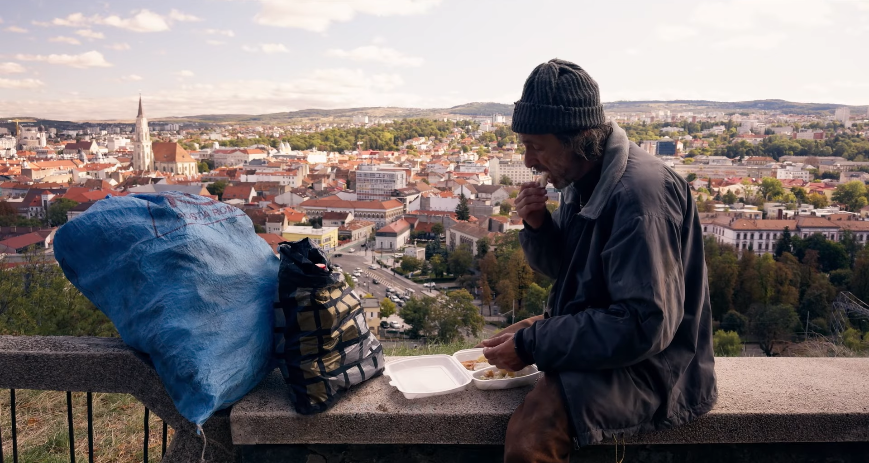
The first ten minutes of Radu Jude’s Kontinental ’25 follow a homeless man shuffling through an amusement park filled with animatronic dinosaurs. He mutters profanities to himself. He collects empty bottles. He wanders into a gentrified city center where nobody sees him. Then he returns to his basement squat, and something terrible happens .
This opening tells you exactly what kind of movie you have signed up for. Romanian filmmaker Radu Jude does not make comfortable cinema. He makes cinema that pokes you in the ribs while you laugh nervously. His previous films include Bad Luck Banging or Loony Porn (a pandemic satire that opens with unsimulated sex) and Do Not Expect Too Much from the End of the World (which features a Uwe Boll cameo and dares critics to like it) .
Kontinental ’25 sands down some of that abrasive edge. It is, as one critic noted, “a Radu Jude film for people who can’t stomach the idea of a Radu Jude film” . The runtime clocks in at a manageable 109 minutes. The humor remains dark, but the dick jokes and Snapchat filters stay home.
What remains is a sharp, unforgiving satire about guilt, gentrification, and the politics of learned helplessness .
What Is Kontinental ’25 Actually About?
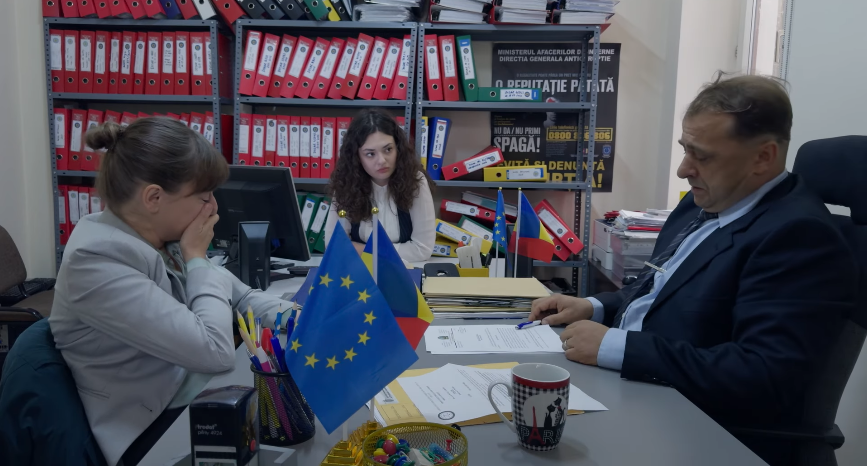
The plot begins simply enough. Orsolya (Eszter Tompa) works as a bailiff in Cluj, Transylvania’s largest city. She speaks Hungarian. She lives a comfortable middle-class life with her husband and children. She evicts people for a living .
One day she arrives at a basement address to remove a homeless man named Ion (Gabriel Spahiu). The building’s owners plan to demolish the structure and erect a boutique hotel called the Kontinental . Orsolya does her job politely, professionally, even humanely. She gives Ion twenty minutes to collect his belongings.
When she returns with the gendarmes, Ion has taken his own life .
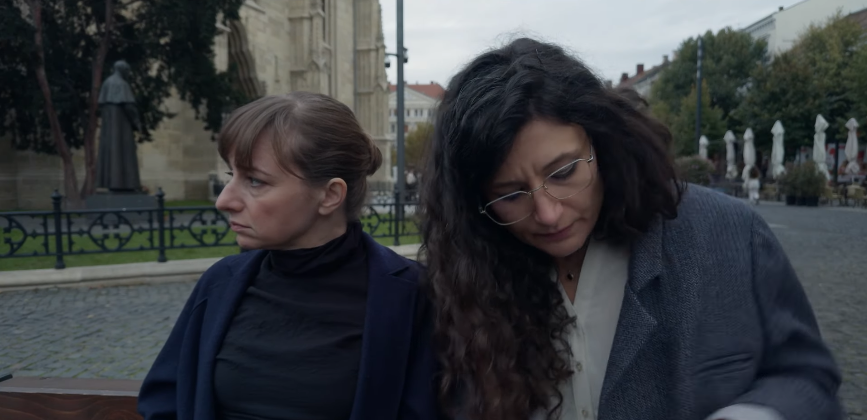
Here the film pivots. The opening belongs to Ion. The remaining ninety minutes belong to Orsolya and her guilt. She cancels a family vacation to Greece. She wanders Cluj searching for someone—anyone—who will tell her she remains a good person. She meets with a friend, a former student, a priest, her mother. She recounts the story seven times in two languages .
Nobody gives her what she wants.
The Rossellini Connection: Europa ’51 Reimagined
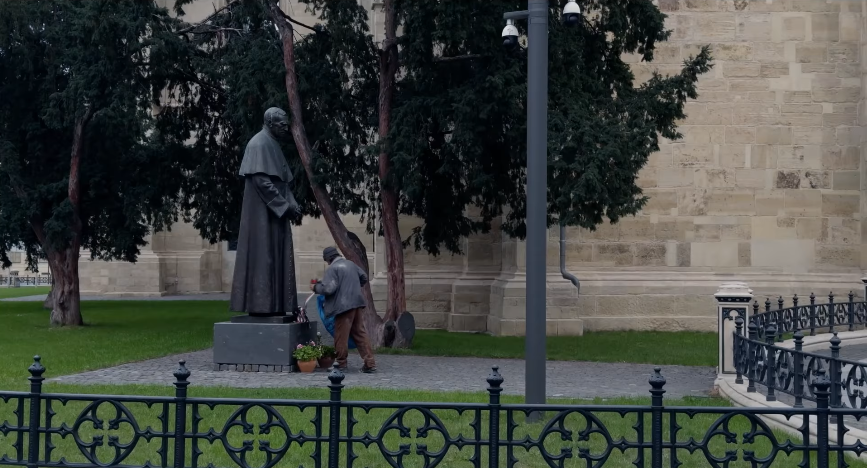
You cannot discuss Kontinental ’25 without acknowledging Roberto Rossellini’s Europa ’51. Jude makes the connection explicit. A poster for Rossellini’s classic hangs in the background of a bar scene. The film’s own poster deliberately mirrors the original .
Rossellini’s film follows a wealthy woman who becomes obsessed with humanitarian work after her son dies by suicide. Jude flips the premise. Orsolya does not become a saint. She becomes something far more recognizable: a modern liberal desperate for external validation.
The Los Angeles Times notes the key difference: “While in Rossellini’s film a woman’s crisis of conscience leads to meaningful activity, here the protagonist facing the dilemma is unable to find anybody to understand her and becomes increasingly desperate for external reassurance” .
Orsolya donates two euros monthly to Gaza and Ukraine. She wants credit for caring. She also wants someone to absolve her complicity in a system that kills people like Ion.
Jude refuses to let her off the hook. And he refuses to let us off either.
Shot on iPhone: Gimmick or Genius?
Here is something you do not see every day: a major festival premiere shot entirely on an iPhone 16 with no artificial lighting .
Jude filmed Kontinental ’25 in ten days while waiting for another project (a Dracula film) to gear up. The production used a small crew and minimal equipment. Passersby stare directly into the lens. The autofocus occasionally hunts. The aesthetic lands somewhere between Dogme 95 rawness and guerilla documentary .
Some critics find the look “garish” and question its purpose . Others see it as a deliberate homage to Rossellini’s “poverty of means” . Jude himself seems unconcerned with prettiness. He wants you to feel the texture of contemporary Cluj—a city rapidly “Europeanizing” through gentrification and real estate speculation .
The iPhone cinematography also serves a thematic function. Jude questions the smartphone’s contribution to our “easy disengagement with the world’s ills” . We watch Orsolya’s crisis through the same device she would use to scroll past bad news on social media.
The effect is uncomfortable. That is the point.
Eszter Tompa: A Performance That Holds the Mess Together
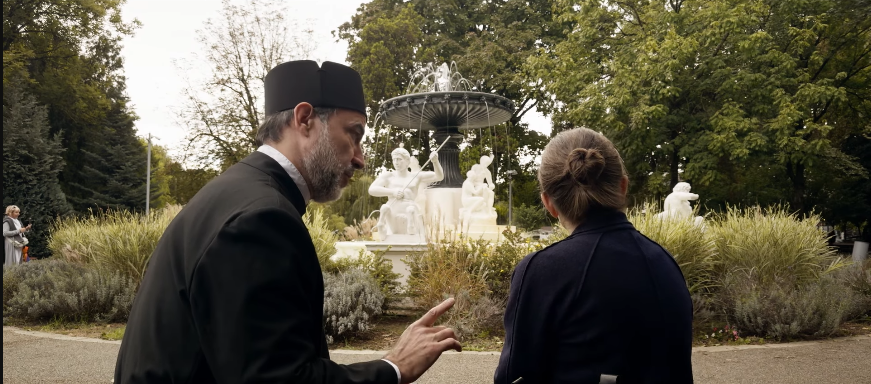
None of this works without Eszter Tompa. The Hungarian-born actress carries nearly every scene, often doing nothing more than talking about herself .
Tompa brings “a deep and relatable sadness” to Orsolya, preventing a character who could easily become insufferable from ever crossing that line . The Los Angeles Times praises her “affecting central performance” and notes how every fiber of her being communicates Orsolya’s sincere if haphazard search for understanding .
She weeps. She drinks. She seeks confession from a priest who offers platitudes instead of absolution. She debates Zen koans with a former student who now works as a bike courier .
The role demands that she remain sympathetic while the film quietly exposes her self-interest. She wants to feel better, not to do better. Tompa lets us see both the genuine pain and the performative grief.
The Conversations: Gabfests with Teeth
Jude structures Kontinental ’25 as a series of extended dialogue scenes. Orsolya talks. People respond. The camera holds. This is Romanian cinema’s signature move—the long, static, intellectually restless conversation—and Jude wields it like a scalpel .
Each encounter reveals another layer of contemporary European dysfunction:
- Her boss mocks her guilt, sarcastically comparing her to Oskar Schindler .
- Her friend shares disgust about another homeless man, then shrugs at a problem she feels powerless to solve .
- Her mother uses the moment to vent splenetic nationalism, reminding everyone that Orsolya is ethnically Hungarian in a Romanian city .
- A former student discusses Zen philosophy and Ice-T while they drink at a cinema-themed bar .
The film becomes a crash course in Jude’s political obsessions: cancel culture, performative activism, anti-capitalist rage, the legacy of colonialism, and the way modern Europe treats its unwanted citizens .
Jude connects historical colonialism (Romanians taking Transylvania, Soviets occupying Romania) to contemporary issues including the war in Ukraine and the situation in Gaza . The scope feels expansive even as the film remains visually intimate.
What Works (And What Tests Patience)
Let us be honest about the film’s limitations.
The pacing will test viewers accustomed to conventional narrative rhythms. The middle section consists almost entirely of people sitting and talking. Jude’s previous films often deployed essayistic techniques or gonzo digressions to break up the gabfests. Kontinental ’25 strips those away .
The supporting cast remains somewhat underdeveloped. Adonis Tanța brings welcome comic relief as the Zen-spouting courier with an opera-singing habit, but other characters function more as sounding boards than fully realized individuals .
The treatment of suicide may strike some viewers as regressive. The film frames Ion’s death primarily as an act of violence against others rather than exploring the internal circumstances that brought him to that point . Ion exists as a plot device. Orsolya exists as a protagonist. The imbalance is deliberate but not entirely satisfying.
The ending offers no resolution. Jude closes with a montage of apartment buildings and construction sites, very few humans visible. The New York Times asks the right question: “Are we looking at a vision of growth or the partitioning of community?”
The film refuses to answer.
The Verdict: A- Cinema, B+ Enjoyment
Kontinental ’25 earned a Silver Bear for Best Screenplay at the 2025 Berlin Film Festival. Critics have greeted it with characteristic admiration for Jude’s intellectual rigor and mild frustration at his relative restraint .
David Ehrlich gave the film a B+, noting that “the deadpan fun comes from Orsolya’s futile search for a shoulder to cry on” while longing for the “16mm richness” of Jude’s previous work .
The Hyperreal Film Club captured the essential tension: “It feels like a Radu Jude film for people who can’t stomach the idea of a Radu Jude film… for those already familiar with the Romanian iconoclast’s repertoire, it will only leave them desiring the full course” .
I land somewhere in the middle.
Reasons to watch:
- Eszter Tompa’s performance. She holds the screen with a vulnerability that never curdles into self-pity.
- The political scope. Jude connects gentrification in Cluj to broader European crises with remarkable efficiency.
- The formal audacity. Shooting a feature on iPhone in ten days deserves respect, even when the results feel deliberately unfinished.
Reasons to hesitate:
- The pacing. You must enjoy watching people talk about their feelings for extended stretches.
- The tonal restraint. Jude’s wilder impulses stay largely in check. This is a more “mature” film, for better and worse.
- The protagonist. Orsolya is sympathetic but also self-absorbed. Some viewers will tire of her search for validation.
Should You See Kontinental ’25?
Yes, with clear expectations.
This is not escapist entertainment. This is a film that asks you to sit with discomfort, to recognize your own small complicities in systems that harm vulnerable people, and to laugh nervously at the absurdity of modern European life.
If you enjoy the work of other Romanian New Wave directors—Cristian Mungiu, Cristi Puiu, Corneliu Porumboiu—you will find familiar pleasures here. If you admired Jude’s previous films for their gonzo energy, you may find this entry comparatively subdued.
The film runs 109 minutes. It screens in Romanian, Hungarian, and German with English subtitles. 1-2 Special opened the film in select US theaters beginning March 27, 2026 .
Go see it. Then spend some time thinking about what you would say if you had to explain yourself seven times in two languages.
The film will not comfort you. That is precisely why it matters.
Rating: ★★★★☆ (4/5)
Runtime: 109 minutes
Language: Romanian, Hungarian, German (English subtitles)
Director: Radu Jude
Cast: Eszter Tompa, Gabriel Spahiu, Adonis Tanța, Oana Mardare, Șerban Pavlu
Festivals: Berlin International Film Festival 2025 (Silver Bear for Best Screenplay)
Kontinental 25 Radu Jude
- Rating8




Leave a comment