


Nearly three decades have passed since Happy Gilmore introduced the world to a hockey-playing, puck-launching, foul-mouthed golf phenom with anger issues and a heart of gold. The 1996 original became one of Adam Sandler’s most enduring cultural artifacts — a genuinely quotable, frequently rewatchable sports comedy that found unlikely resonance in both mainstream pop culture and the golf community. For 29 years, fans waited. Now, Happy Gilmore 2 has arrived, and the question the internet has been asking since the first trailer dropped is finally answerable: does it deliver?
The short answer is: partially, and messily, and often in spite of itself — but also sometimes brilliantly. The longer answer requires confronting what this film actually is, what it was trying to be, and what it reveals about both Adam Sandler’s evolution as a comedian and the broader challenge of reviving beloved comedy franchises in the streaming era.
Happy Gilmore 2 was released on Netflix on July 25, 2025, and received mixed reviews. For the week of July 21–27, it ranked first on Netflix’s list of English-language movies, drawing 46.7 million views in three days — making it the biggest U.S. Netflix film debut of the year. Those numbers tell you everything about audience appetite and nothing about artistic merit, which is precisely why a thorough review is warranted.
Quick Facts: Everything You Need to Know
Before diving into the analysis, here is a concise reference guide to the film’s essential details:
Director: Kyle Newacheck
Writers: Adam Sandler and Tim Herlihy
Runtime: 114 minutes
Rating: PG-13 (for strong language, crude/sexual material, partial nudity, and some thematic material) Streaming Platform: Netflix (exclusively)
Release Date: July 25, 2025
Rotten Tomatoes Score: 62% critics, mixed audience response
Production: Filming took place in New Jersey from September to December 2024.
Plot Summary: From Champion to Rock Bottom — and Back Again
After winning his first Tour Championship in 1996, Happy Gilmore enjoyed a successful golf career, winning five more championships and marrying Virginia, who also served as the professional golf tour’s public relations director. Life, in other words, delivered on its promise — until it catastrophically did not.
Without giving away the brutal details, Virginia exits the picture early on in what the film maintains is the dubious sequel tradition of the Disposable Love Interest, as seen in films ranging from The Karate Kid II to Ted 2 to Austin Powers: The Spy Who Shagged Me. Happy goes broke, loses his late grandmother’s house, turns to the bottle, and gets into scrapes with the law, eventually finding himself in a rehab facility run by an old nemesis.
The central motivation driving Happy’s return to competitive golf is genuinely touching: his youngest child, daughter Vienna (played by Sandler’s real-life daughter Sunny Sandler), has been accepted to the Paris Opera Ballet School. The tuition is unaffordable on Happy’s current income. So, reluctantly and ungracefully, the man who once drove a golf ball 400 yards with a hockey-player’s slapshot returns to the one arena where he was undeniably, legendarily great.
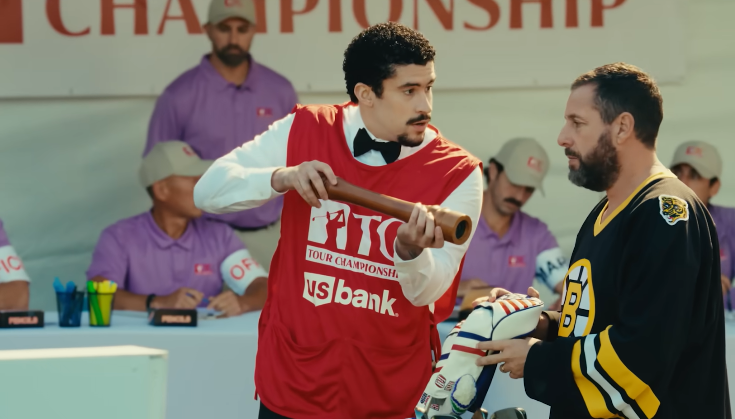
The antagonist of the piece is Frank Manatee (Benny Safdie), an energy drink mogul who is starting a new golf league called Maxi Golf — essentially an exaggerated version of the real-world LIV Golf, designed to amp up the game and attract a younger, hipper audience. Eighteen holes? Boring. Seven holes. Slow play? Shot clocks. The challenge that structures the film’s third act pits traditional golf’s top finishers against Maxi Golf’s representatives — and if Happy can earn his place on the team, he might just secure his daughter’s future and reclaim his own dignity in the process.
Direction: Kyle Newacheck’s Steady, Unflashy Hand
Happy Gilmore 2 is directed with a firm if sometimes self-indulgent sense of comedic timing by Kyle Newacheck from a joke-crammed screenplay by Sandler and his longtime writing partner Tim Herlihy.
Newacheck, best known for his work on the Netflix series Game Over, Man!, brings a workmanlike competence to the material that largely serves the film’s needs without elevating them. He understands Sandler’s comedic rhythms intuitively, knows when to linger on a physical gag and when to cut away before it overstays its welcome, and manages the film’s unusually large cast with sufficient organizational clarity that the constant parade of faces never becomes genuinely confusing.
Where Newacheck’s direction falls short is in tonal differentiation. The film’s more emotionally earnest moments — and there are genuine ones, particularly early on — require a tonal softness that the director struggles to maintain when the comedy’s slapstick engine is continuously running. The juxtaposition of genuine grief with broad physical comedy is achievable (Sandler himself has demonstrated this in films like Click and Uncut Gems), but it requires a director confident enough to slow the pace and let emotion breathe. Newacheck keeps his foot on the accelerator when the film occasionally needs him to coast.
Adam Sandler’s Performance: Surprising Depth in Familiar Territory
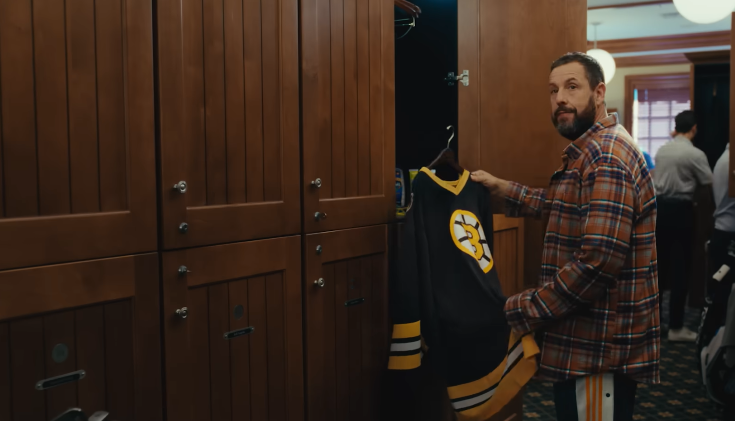
A More Complex Happy
The most genuinely surprising element of Happy Gilmore 2 is the quality of Sandler’s performance, which displays dimensions the original film never required or attempted.
In the film’s early section, Sandler shows legitimate chops. He balances absurdity — everything Happy owns is a flask in disguise — with legitimate emotional distress and love for his family. It is the kind of performance Sandler could not have managed while shooting the original in his late 20s. While his concern for his grandmother in 1996 did not feel false, there is a depth here that that movie never managed.
This observation is important because it reframes what might otherwise be dismissed as nostalgia bait. Sandler at 58 brings the weight of age, loss, and genuine paternal feeling to a character who, in 1996, was primarily a vehicle for anarchic comedy. The film has something genuinely interesting to say about what it means to be a middle-aged man trying to reconnect with the best version of himself — and Sandler, when the screenplay allows him space to convey this, delivers it with real feeling.
When the Comedian Outpaces the Material
The frustration, consequently, is that the screenplay’s relentless comedy machinery frequently intrudes on the characterization before it fully develops. What’s most important in making it work to the degree it does is Sandler himself, who never goes over the top, silly as the situations can be, but rather keeps it grounded, and believe it or not with a semblance of a credible setup for Happy circa 2025.
The Cast: Returning Favorites, Bold New Arrivals
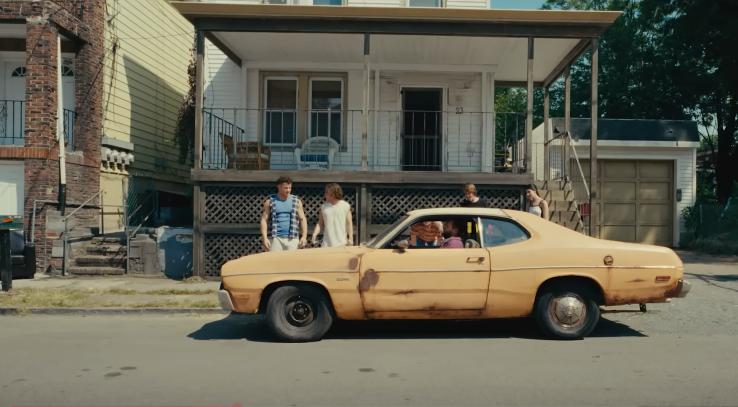
Christopher McDonald as Shooter McGavin
The reunion between Sandler and Christopher McDonald as the deliciously loathsome Shooter McGavin represents one of the sequel’s most effective choices. McDonald has lost none of his instinct for comic villainy, and the screenplay wisely repositions Shooter in a way that acknowledges the passage of time without simply repeating his original function. Christopher McDonald’s character suffered a mental breakdown following his defeat at the Tour Championship at the end of the first film, and this backstory informs a portrayal that is simultaneously funnier and more sympathetic than the original incarnation.
Ben Stiller as Hal L.
Ben Stiller reprises his role as Hal L., the abusive leader of a support group for alcoholics, somehow managing not to be funny. This assessment, while pointed, reflects a genuine issue with how Stiller’s character is deployed — the rehabilitation facility scenes feel mechanically structured around the function of getting Happy sober rather than organically emerging from character dynamics.
Bad Bunny as Oscar Mejías
As the caddy Oscar Mejías, Bad Bunny warned Adam Sandler on screen, “I’m stealing this movie right out from underneath you” — and he nearly does. The Puerto Rican musician and actor brings unexpected comedic confidence to a role that could easily have been decorative. His chemistry with Sandler generates some of the film’s most genuinely funny exchanges, and his character’s subplot — a former busboy who dreams of owning a restaurant — provides the film with a second emotional current that enriches its thematic texture without competing with Happy’s central arc.
Sunny Sandler as Vienna
As Vienna, Happy’s daughter and primary motivation, Sunny Sandler demonstrates that the eldest Sandler child has inherited her father’s natural screen comfort without yet developing his comic precision. The character functions effectively as an emotional anchor, but the screenplay underserves her, keeping Vienna primarily in reactive mode rather than granting her the autonomous personality that her father’s journey deserves.
The Ensemble of Sandler Regulars
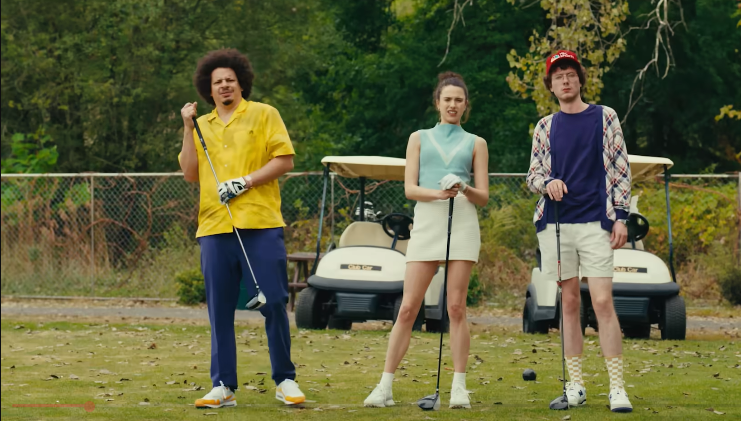
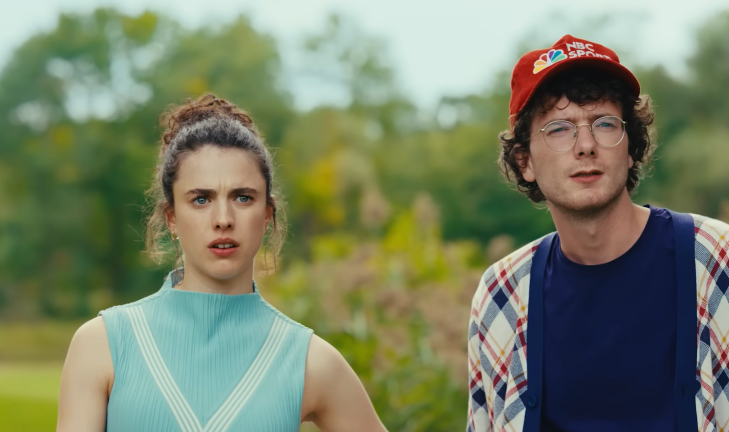
The film continues Sandler’s established tradition of employing friends and family in supporting roles. Steve Buscemi portrays the Gilmores’ neighbor Pat, with Eric André, Martin Herlihy, and Margaret Qualley appearing as a trio of young golfers, while Austin Post (Post Malone) portrays DJ Omar Gosh and Kid Cudi plays an FBI agent. Each presence delivers what it is designed to deliver — a jolt of recognition, a brief comedic beat — without materially advancing the story.
The Cameo Question: Spectacular Excess or Structural Problem?
No aspect of Happy Gilmore 2 has attracted more critical discussion than its extraordinary density of celebrity appearances. The film features an almost dizzying number of celebrity cameos, including professional golfers Rory McIlroy, Scottie Scheffler, Brooks Koepka, Jordan Spieth, Jack Nicklaus, and many others, alongside entertainers and athletes including Travis Kelce, Eminem, and numerous others.
The blink-and-you-miss-them cameos are almost dizzying and dropped in constantly, breaking the fourth, fifth, sixth, and seventh wall for some nonsensical fun, which is all this movie aims to be.
In this regard, Sandler has become a kind of new-age Bob Hope who once even had Arnold Palmer play through in his 1960s golf comedy.
The cameo-saturation does generate a real dramatic problem, however. Happy Gilmore 2‘s level of cameos is genuinely baffling — from golf stars to comedic actors and musicians. The film tries to outdo the first movie in every way, including cameos, and this insistence on being bigger hinders it.
The original film’s success derived partly from the fact that the Bob Barker fight sequence emerged organically from the story rather than feeling like a scheduled appearance. Happy Gilmore 2 rarely achieves that integration, which means its cameo sequences function more as variety show segments than as genuinely funny story moments.
Honoring the Lost: Carl Weathers, and the Film’s Melancholy Heart
Perhaps the most affecting dimension of Happy Gilmore 2 involves how it acknowledges the friends and collaborators who did not live to see its completion.
Carl Weathers, who played Chubbs Peterson in the first film, died in February 2024 at age 76. Despite his character’s death in the first film, he was set to reprise his role appearing as a ghost in Happy’s dreams. Weathers’ death forced a heavy rewrite. Sandler stated: “We had a painful change. Carl Weathers had a massive part. I would talk to Carl, and we were excited, and then Carl passed away. We had to rewrite a lot of the stuff, and even what the story was. We made a lot of nice references to how great Chubbs was in the movie. That was the biggest change.”
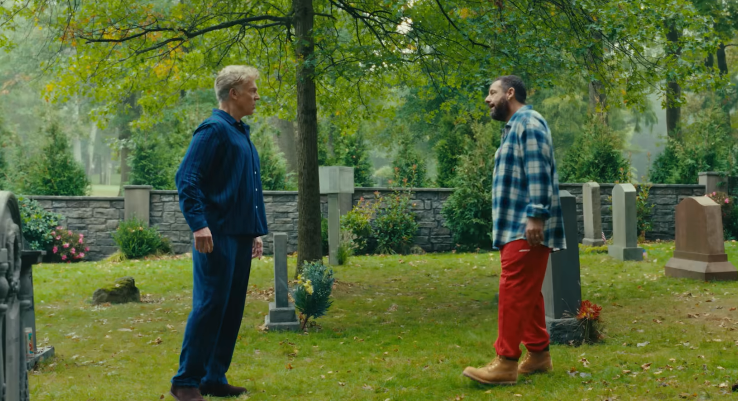
Sandler and company pay homage to the now-deceased members of the 1996 film including a clever scene in a cemetery right above Bob Barker’s grave, as well as tributes to Carl Weathers’ Chubbs, Frances Bay’s Grandma, and Richard Kiel’s Mr. Larson.
Reminders throughout the film of those lost, both fictionally (Julie Bowen’s Virginia) and in reality (Carl Weathers, Joe Flaherty, Richard Kiel, Frances Bay), inform a persistent sense of melancholy that distinguishes Happy Gilmore 2 from a straightforward nostalgia exercise.
These moments of genuine grief and remembrance represent the film at its most emotionally honest, and they elevate what might otherwise be a purely comedic enterprise into something with actual human texture.
Thematic Analysis: Old-School vs. New-School, and What We’re Really Protecting
Happy Gilmore 2 is more thematically coherent than its surface chaos suggests. The Maxi Golf subplot — with its shot clocks, reduced hole counts, and energy-drink-fueled spectacle — functions as an explicit allegory for the tension between tradition and disruption that characterizes numerous cultural conversations in 2025.
A modern critic might point out the irony of yesterday’s outsider becoming today’s guardian of old-school wisdom. This observation is perceptive. Happy Gilmore in 1996 was the rebel who disrupted professional golf’s staid establishment. Happy Gilmore in 2025 is the establishment defending itself against a newer, louder disruption. The film does not resolve this irony so much as it acknowledges it with a knowing shrug — which is perhaps the most honest response available.
The father-daughter dynamic at the film’s center grounds these thematic concerns in something personal. Happy’s desire to fund Vienna’s ballet career is not simply a plot mechanism but a statement about what parents owe their children: the chance to pursue an authentic self, regardless of what the world offers as easier alternatives.
The Verdict on Comedy: What Works, What Doesn’t
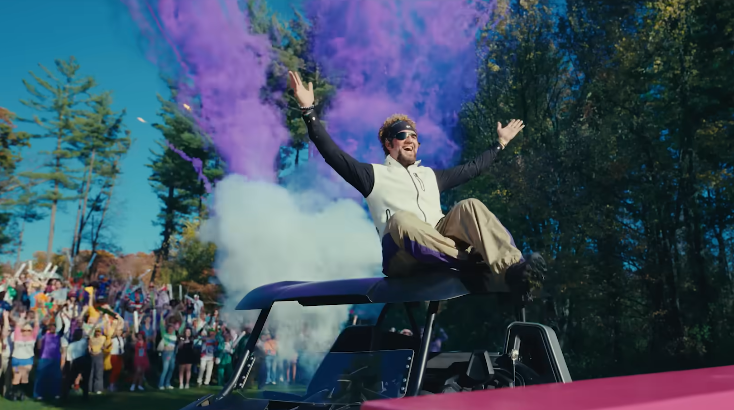
Happy Gilmore 2 is funny in bursts and labored in between. The physical comedy — Sandler’s hockey-swing driving, his confrontations with antagonists, his body’s betrayals during his return to competitive form — generates genuine laughs and demonstrates that Sandler’s gift for physical performance remains intact. Certain running jokes, particularly those involving Happy’s sons having inherited his legendary temper, pay off with the accumulated force of repetition done correctly.
The scatological humor is as low-brow as it gets. Either you find it funny or you don’t. The physical, Three Stooges-style slapstick material has a certain, admittedly dumb, appeal. Happy Gilmore 2 makes par through the strength of its sheer stupid energy and the game efforts of Sandler and his 50-or-so co-stars.
Where the comedy consistently fails is in its recycled callbacks to the original. There are so many clips from its predecessor and returning performers that the result is less a continuation than an exercise in fan service. The Hollywood Reporter Callbacks work best when they surprise — when a film trusts its audience to remember without prompting. Happy Gilmore 2 does not always extend this trust, and its insistence on reminding viewers of what made the original great paradoxically underscores how rarely the sequel achieves the same spontaneous inspiration.
Netflix Viewership Records: Context for the Numbers
The film’s cultural impact, regardless of its critical reception, demands acknowledgment. Happy Gilmore 2 stormed onto Netflix with 2.9 billion viewing minutes in its opening weekend, instantly becoming the most-watched film in Nielsen’s Top 10 history — surpassing the record previously held by Glass Onion. It posted the biggest opening week ever for a Sandler film on the platform.
The sequel’s release also boosted interest in the original Happy Gilmore, which ranked at No. 3 on the global Top 10 with 11.4 million views, marking its second consecutive week on the list.
Since 2018, Sandler’s Netflix films have generated more than 61 billion viewing minutes, making him one of the platform’s most bankable stars. These numbers contextualise Happy Gilmore 2 not as an isolated film event but as the latest expression of one of the most consistent and commercially potent partnerships in the history of streaming entertainment.
For context on the original film’s legacy and how it compares to its sequel, readers can explore the comprehensive Wikipedia article on Happy Gilmore and the Variety viewership report covering the sequel’s record-breaking debut.
Frequently Asked Questions
Do I need to watch the original Happy Gilmore first? You might be tempted to rewatch the 1996 original before taking in the sequel, but there’s really no need. There are so many clips from its predecessor that even those who never saw the original will have no trouble catching up. That said, long time fans will extract considerably more pleasure from the callbacks, tributes, and returning cast members if the original is fresh in memory.
Is Happy Gilmore 2 appropriate for families? The film carries a PG-13 rating for strong language, crude and sexual material, partial nudity, and some thematic material — including alcoholism and bereavement. Parents should be aware that the film’s darker opening acts address grief and addiction in ways that younger children may find confusing or distressing.
Where can I watch Happy Gilmore 2? The film was released exclusively on Netflix on July 25, 2025. A standard Netflix subscription provides full access.
Is Carl Weathers in the film? Carl Weathers died in February 2024 and does not appear in the film. However, his character Chubbs Peterson receives meaningful tributes throughout.
How does it compare to the original? Most critics and many audience members agree that the sequel does not reach the original’s comedic heights, though it delivers enough genuine laughs, emotional texture, and nostalgic satisfaction to constitute a worthwhile — if imperfect — viewing experience for fans of the franchise.
Conclusion: A Warm, Imperfect Return to the Happy Place
Happy Gilmore 2 is not the film it could have been, and it is also not the film its detractors suggest. It is a generously proportioned, frequently funny, occasionally moving, and persistently overcrowded sequel that respects its source material almost too reverently to transcend it. Adam Sandler delivers one of the more emotionally layered performances of his comedy career within a film that repeatedly interrupts that emotional work with celebrity appearances and callbacks to moments audiences already cherish.
Sandler and company are giving the fans exactly what they want with this live-action cartoon. It’s good to be back in that Happy Place.
The film works best as an event — something to watch with people who love the original, who will laugh at the callbacks, appreciate the tributes to the lost, and accept its structural imperfections with the same affectionate tolerance they bring to re-watching a beloved comedy that was never technically perfect either.



Leave a comment