


A Businessman’s Second Act — and His Most Interesting One Yet
Tamil cinema has always made space for the businessman-turned-actor. It is a tradition that relies partly on curiosity, partly on commercial ambition, and entirely on the goodwill of an audience willing to suspend considerable disbelief. When Saravanan Yogarathinam — better known as Legend Saravanan, the retail entrepreneur behind the Legend Saravana Stores chain — arrived on cinema screens with The Legend in 2022, the film became a case study in self-financed vanity projects: outrageously over-the-top, critically demolished, and yet perversely memorable.
Leader, his sophomore outing, is a different proposition entirely. Produced again under his own Legend Saravana Stores Productions banner and directed by the commercially seasoned R. S. Durai Senthilkumar — the filmmaker behind Ethir Neechal (2013), Kaaki Sattai (2015), Kodi (2016), and most recently Garudan (2024) — the film represents an explicit course correction. The bombast has been dialled back. The character has been deliberately restrained. The story, set against the gritty industrial backdrop of Thoothukudi’s port, engages with actual genre mechanics: spycraft, conspiracy, and the hidden-identity thriller format that Tamil cinema’s best commercial films have used to electrifying effect.
The result is a film that divides critics but rewards genre fans — one that carries the DNA of its director’s smartest commercial instincts while periodically tripping over its own ambition. Leader is not a great film. It is, however, a genuinely watchable one, and for audiences who have written off Legend Saravanan after his debut, that in itself is worth noting.
Plot Overview: The Mechanic of Thoothukudi Harbours Many Secrets
Leader unfolds in Thoothukudi — a major port city on Tamil Nadu’s southern coast, where the hum of container ships and the tang of sea salt provide an appropriately atmospheric setting for a story built around concealment, corruption, and controlled chaos. Sakthivel (Legend Saravanan) presents himself to the world as a modest car mechanic working at a dock controlled by a local crime boss named Salt (Prabhakar). He is a dedicated father to his daughter Irene (Iyal), a man whose entire visible existence seems constructed around quiet domesticity.
Beneath that surface, however, the narrative is gathering several combustible threads. Salt operates as part of a broader criminal conspiracy — one that involves a dangerous international syndicate led by a figure known only as The Devil (Santhosh Prathap) and a scheme centred on illegal ammonium nitrate shipments that threaten the port’s safety on a catastrophic scale. Simultaneously, Inspector Chandhra Sathyamoorthy (Andrea Jeremiah), a driven and incorruptible police officer, attempts to penetrate the criminal network from the outside, facing resistance from compromised superiors at every step. Her tentative alliance with SP Bakthavachalam (Shaam) forms the investigative spine of the film’s first half.
The film’s structure follows a well-worn but effective hidden-identity template: a seemingly ordinary protagonist carries a classified past that the narrative withholds until a strategically chosen mid-point reveal. The interval twist — which signals that Sakthivel is considerably more than a mechanic — pivots the story from a taut crime drama into a covert-ops thriller, opening the second half onto international locations including what appears to be Eastern Europe, where a covert mission to rescue trapped Indian civilians from a fictional country becomes the action canvas. The film also threads in an evil twin subplot for the primary villain and a medically improbable condition for Irene that, for a certain subset of the audience, will achieve immediate cult notoriety.
Release Date: April 3, 2026
Director: R. S. Durai Senthilkumar
Cast: Legend Saravanan, Andrea Jeremiah, Shaam, Santhosh Prathap, Payal Rajput, Lal, Iyal, Prabhakar, VTV Ganesh, Amritha Aiyer
Screenplay: R. S. Durai Senthilkumar, MVS Bharadwaj, Shravan Madala
Music: Ghibran Vaibodha
Cinematography: Venkatesh S.
Editing: Pradeep E. Ragav
Producer: Legend Saravanan (Legend Saravana Stores Productions)
Runtime: 2 hours 26 minutes
Certificate: U/A
Languages: Tamil (also released in Telugu)
Our Rating: ★★★ / 5
Direction: Durai Senthilkumar Navigates a Difficult Brief With Considerable Craft
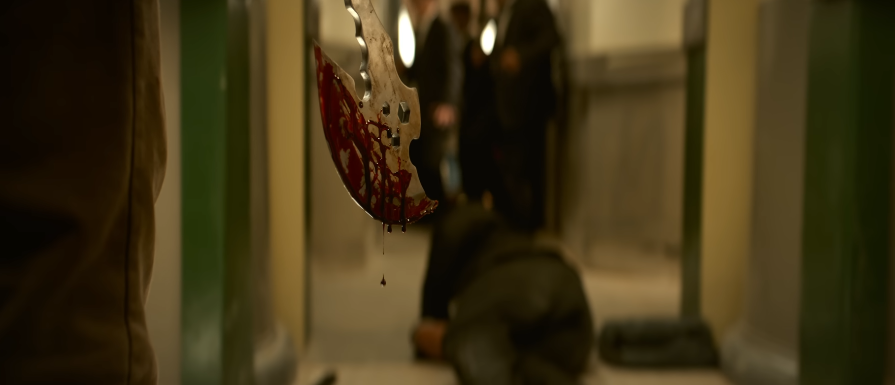
RS Durai Senthilkumar’s filmography reads as an interesting study in commercial versatility. With Ethir Neechal, he played a vital role in reshaping Sivakarthikeyan’s comedic image as the star navigated toward mass-hero territory. With Kaaki Sattai, he continued that project with precision and crowd-pleasing instinct. Kodi showed his ability to handle more textured, emotionally layered drama for a star — Dhanush — who was deliberately repositioning himself for mature roles. And Garudan (2024) demonstrated perhaps his most impressive image-crafting achievement: successfully elevating Soori, an actor with no prior hero-film track record, into a commercially viable lead.
Leader represents a similar brief — arguably his most challenging yet. Legend Saravanan is a figure who carries the baggage of The Legend‘s viral mockery, a debut so self-serious and technically underprepared that it generated internet ridicule. Durai Senthilkumar’s strategy in response is worth examining because it is largely intelligent: he strips the bombast, imposes restraint on his lead, and builds a genre film competent enough to carry Saravanan on its structural merit rather than demanding that he generate charisma through sheer force of will.
The director demonstrates real command over the film’s commercial architecture. He seeds small narrative details early — a hearing aid here, a specific photograph there, a wrist-watch device — that coalesce into payoffs in the third act with satisfying click. The pre-interval action stretch is described by multiple critics as one of the film’s major highlights: kinetic, well-paced, and executed with genuine technical confidence. The Vande Bharat train fight sequence, which draws favourable comparisons to the corridor-fight format popularised by films like Kill (2024), earns its place as a centrepiece set piece.
Where Durai Senthilkumar’s direction falls short is in the connective tissue between these high points. The first half’s pacing is uneven, and some of the emotional beats — particularly those designed to establish our investment in Sakthivel’s father-daughter relationship — feel telegraphed rather than earned. The leap from Thoothukudi crime drama to international covert operation requires a tonal adjustment that the film manages but does not navigate smoothly. The second half is considerably stronger and more focused, suggesting that the director’s confidence grew as the production proceeded.
Nevertheless, the overall achievement is considerable: Durai Senthilkumar has delivered a commercial thriller functional and entertaining enough to make Legend Saravanan seem plausibly cast in an action-hero role. Given the context of that undertaking, that is no small feat.
Performances: Saravanan Plays It Straight, and the Strategy Mostly Works
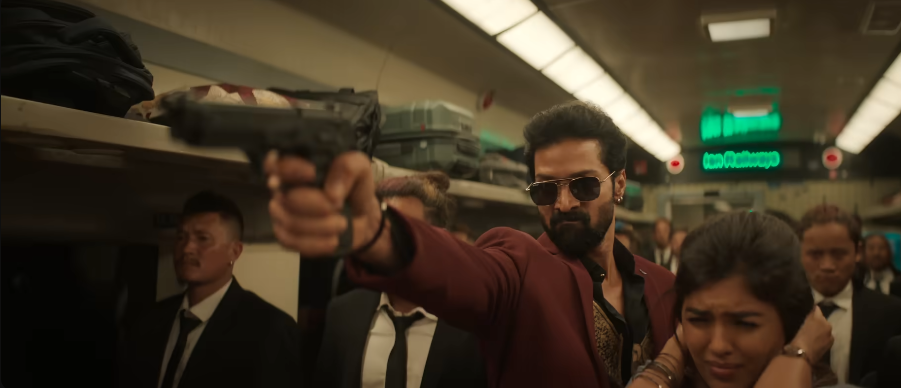
Legend Saravanan as Sakthivel
The most notable decision in Leader‘s approach to its leading man is the choice of restraint. Sakthivel is described in the script as “glum, serious, and speaks sparingly” — and Saravanan maintains that register with a consistency that, while it cannot disguise all technical limitations, at least prevents the film from becoming the unintentional comedy showcase that The Legend descended into.
The ETimes review captured this accurately: Saravanan has been given a character that plays to his natural strengths, and he maintains that register throughout. He won’t be asked to carry heavy emotional lifting alone. The action sequences, choreographed by Mahesh Mathew, give his physical presence something concrete to anchor, and Saravanan acquits himself credibly in several of the film’s kinetic set pieces. The Hindu’s Bhuvanesh Chandar observed that in this second outing, Saravanan has “discovered the easier route to becoming a mainstream hero: he doesn’t try to act.” There is a melodramatic moment that briefly exposes his limitations, but he has largely submitted to a director who shows maturity in managing his lead.
The improvement since The Legend is genuine and meaningful, even if Saravanan’s ceiling as an expressive actor remains — for the moment — visible and near.
Andrea Jeremiah as Inspector Chandhra Sathyamoorthy
Andrea Jeremiah is, without qualification, the film’s most accomplished performer. Her Inspector Chandhra is sharp, driven, and impossible to dismiss — a police officer who refuses to fold under institutional pressure and whose investigative determination provides the film with its most credible dramatic energy. Jeremiah has always been a performer of considerable technical skill, and she brings real depth to a role that, in lesser hands, might have functioned merely as a narrative device.
Her combination scenes with Legend Saravanan are among the film’s most tonally complex — she inhabits her character with a naturalism that throws his restraint into useful relief, creating a dynamic that works more effectively than the writing strictly deserves.
Shaam, Santhosh Prathap, and the Supporting Cast
Shaam brings his characteristically composed and trustworthy authority to SP Bakthavachalam, though the character’s backstory — involving a family history in law enforcement that sets up a late-film payoff — is underdeveloped enough to deflate that payoff when it arrives. Santhosh Prathap delivers a cold and menacing villain in The Devil, benefiting from the international setting that gives his antagonist a scope and credibility that port-city crime bosses rarely command. Prabhakar as the local kingpin Salt is effectively ruthless, and Lal lends the film gravitas in his supporting role.
Payal Rajput’s female lead role, meanwhile, is so severely underwritten that it barely registers as a character. Her presence in the film raises expectations that the screenplay consistently fails to meet.
Technical Achievements: Ghibran’s Score and the Thoothukudi Atmosphere
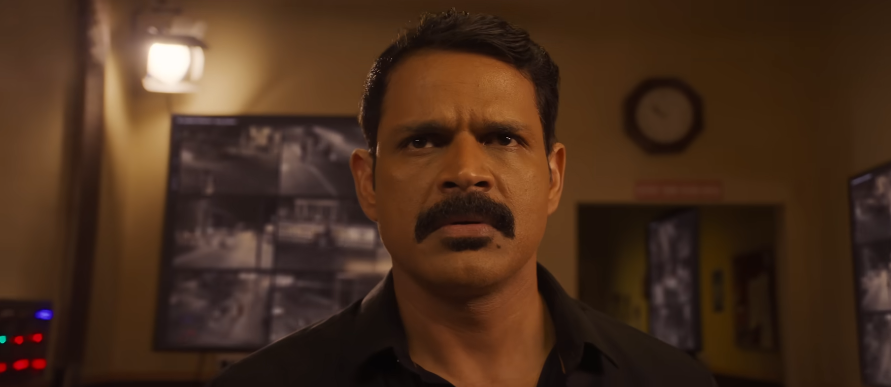
Music and Background Score: Ghibran Vaibodha
Leader marks Ghibran Vaibodha’s first collaboration with both Legend Saravanan and RS Durai Senthilkumar, and the background score represents his most significant contribution to the film’s success. Multiple critics and audience members have specifically identified Ghibran’s BGM as the film’s technical backbone — capable of elevating the spy thriller’s covert-ops sequences and the father-daughter emotional moments with equal authority. The sound design, particularly during the action set pieces and the pre-interval stretch, provides the kind of sonic texture that distinguishes a well-mounted commercial film from its lower-budgeted peers.
The film’s songs, in keeping with a broader trend in contemporary Tamil action thrillers, take a back seat to the BGM — a choice that serves the narrative tone effectively.
Cinematography: Venkatesh S.
Cinematographer Venkatesh S. handles the film’s dual visual registers — the gritty, industrial textures of Thoothukudi’s port environment and the wider, colder vistas of the Georgian international locations — with confident professionalism. The action sequences are shot with clarity and spatial logic, which is more than can be said for many contemporary Tamil action films where kinetic editing obscures rather than clarifies the choreography. The Vande Bharat train sequence, in particular, benefits from cinematography that keeps the audience oriented through a complex and tightly staged fight.
Production Design and Shooting Locations
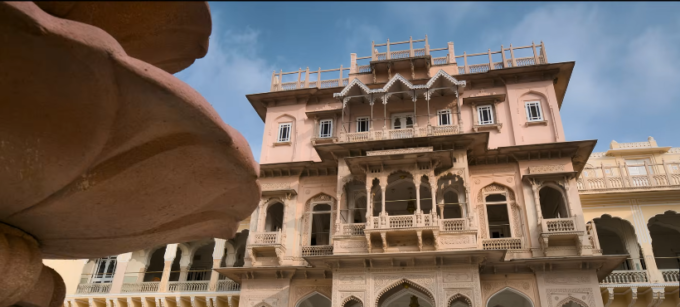
The decision to shoot across genuinely diverse locations — Thoothukudi, Jaipur, Ooty, Georgia, and Chennai — gives Leader a visual range that punches above the weight of a mid-budget Tamil action drama. The Georgian sequences provide the international syndicate subplot with an authentic sense of geography and scale. Principal photography, which ran from June 2024 through September 2025, allowed for an extended post-production phase that contributes to the film’s polished technical presentation.
Narrative Analysis: The Hidden-Identity Template and Its Cult Detours
Leader operates within Tamil cinema’s long tradition of the hidden-identity thriller — a format that uses the reveal of an ordinary protagonist’s extraordinary past as its primary structural engine. The lineage includes Sardar (2022), Vivegam (2017), and Thupparivaalan (2017), among many others. What distinguishes Leader‘s deployment of this template is not its originality but the calibration of its absurdities.
The film’s most notorious inventions — a fictional Eastern European nation called “Elargia” that the screenplay uses as a canvas for the hero’s covert operation history; a medical condition called “textrachondria” attributed to Irene, in which her heart is oddly positioned; an evil twin subplot for the villain; a photograph of Tom Cruise that the daughter believes depicts her father — operate on a frequency that sits somewhere between knowing pulp and inadvertent surrealism. These elements arrive in the second half with such unblinking commitment that they cross from cringeworthy into genuinely entertaining territory.
The screenplay, credited to Durai Senthilkumar, MVS Bharadwaj, and Shravan Madala, feels in these moments as though two different creative energies are competing: one that wants to construct a disciplined, Hitchcock-influenced conspiracy thriller with legitimate third-act payoffs, and another that cannot resist the gravitational pull of Tamil commercial cinema’s most enthusiastically illogical traditions. The result is a film that is frequently uneven but rarely, in the second half especially, boring.
The interval twist — which converts Sakthivel from mechanic to covert operative — is, as several critics have noted, visible from some distance. The screenplay plants the seeds of this reveal with insufficient subtlety, which means the twist lands with less impact than the film intends. The climactic payoff involving the hearing aid, the photograph, and the wrist-watch device, however, does arrive with the satisfying click of well-planted narrative details.
Box Office Performance: A Modest but Meaningful Opening
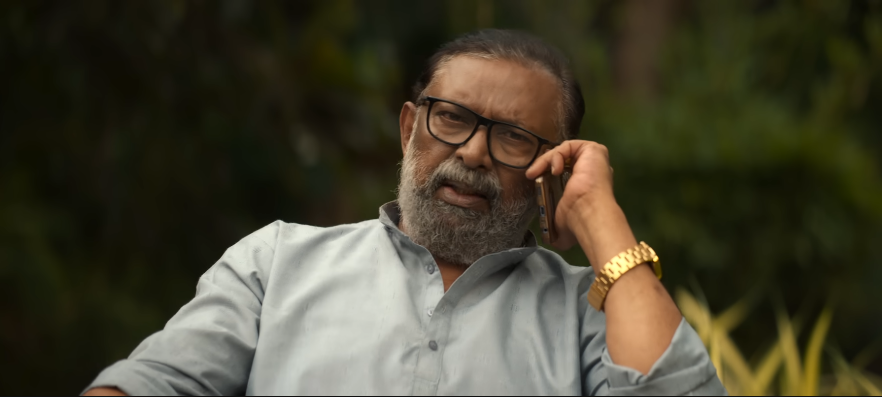
Leader opened on April 3, 2026 — coinciding with Good Friday — and registered an India net collection of approximately ₹75 lakh on its first day, across more than 300 screens in Tamil Nadu, with an overall occupancy of approximately 21%. According to Sacnilk data, morning shows opened at 1.44% occupancy, rising gradually through the day to peak at 29.45% during the night shows. Day 2 saw a 52% jump to ₹1.14 crore, bringing the two-day India net collection to ₹1.89 crore.
The numbers are modest by the standards of established Tamil commercial heroes, but they represent a meaningful data point for a businessman-actor’s second film — particularly one carrying the reputational weight of The Legend‘s critical demolition. The film released across Tamil Nadu primarily, with supplementary Telugu-dubbed versions in select Andhra Pradesh and Telangana markets. Overseas performance was described as negligible, underscoring the film’s decidedly regional commercial footprint.
As Tenvow’s box office analysis notes, the film’s early performance reflects “curiosity around Legend Saravanan’s mass appeal and the high-octane action sequences showcased in the trailer.” Positive word-of-mouth centred specifically on the second half and climax sequences suggests that weekend collections had the potential to improve meaningfully from the modest opening-day baseline.
Critical Consensus: A Divided but Instructive Verdict
The critical response to Leader has been genuinely mixed — and the gap between critical and audience reactions reveals something interesting about the film’s dual nature.
Critics who approach the film with expectations of coherent, logically airtight storytelling find the screenplay’s gaps and absurdities frustrating. The Lensmenreviews assessment describes the writing as “hilariously bad” and notes that Durai Senthilkumar appears to have assembled the film from Saravanan’s list of favourite commercial cinema moments, connected by the most outlandish logic available. The review, while pointed, is not entirely wrong about the screenplay’s architecture.
Critics who engage with the film as commercial mass entertainment arrive at considerably warmer verdicts. Hans India describes the film as offering “a more grounded and confident version of Saravanan on screen” with strong action sequences and a brisk second half. Tenvow awarded 3.5/5, praising Saravanan’s performance and the father-daughter emotional core. The Hindu’s Bhuvanesh Chandar noted Saravanan’s improvement with particular precision, identifying the director’s disciplined management of his lead as the key strategic achievement.
The ETimes verdict — that Saravanan “has noticeably improved since his debut” and that the film maintains its register with consistency — represents perhaps the fairest and most useful framing for general audiences trying to calibrate their expectations.
RS Durai Senthilkumar: The Star-Making Machine and Its Methodology
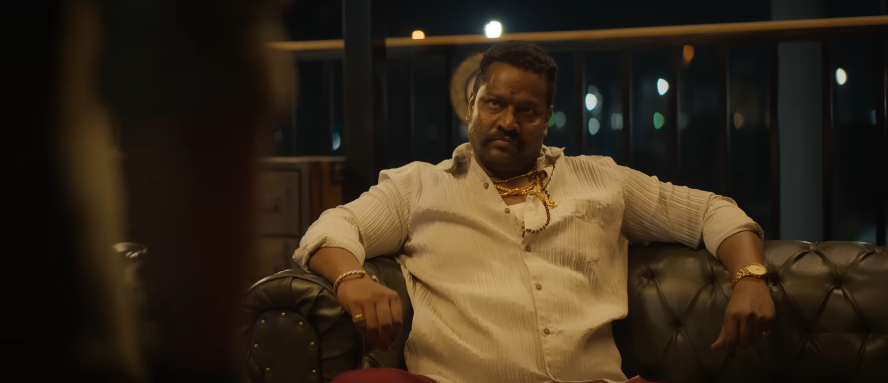
One of the most consistently interesting dimensions of Leader is what it reveals about Durai Senthilkumar’s approach to actor image management. His track record in this specific discipline is remarkable. Ethir Neechal and Kaaki Sattai helped Sivakarthikeyan transition from comedian to mass hero. Kodi repositioned Dhanush for more textured dramatic roles. Garudan performed perhaps his greatest feat: launching Soori — a character actor with no prior headline-film experience — into a commercially viable lead role that the industry accepted without significant resistance.
The strategic logic of attaching this particular director to Legend Saravanan’s second film is immediately apparent. Durai Senthilkumar understands how to use narrative structure, genre mechanics, and supporting cast calibration to carry an actor whose personal charisma cannot yet sustain a film independently. He embeds the lead within a framework strong enough that the audience responds to the genre experience, and the actor benefits from that reflected momentum.
Whether this strategy produces a star or merely a commercially sustainable actor will depend on what comes next for Legend Saravanan. Leader demonstrates that, with the right director and the right brief, he is at least capable of occupying the centre of a functional commercial entertainment without the film collapsing under scrutiny. That is a lower bar than Tamil cinema’s established mass heroes must clear — but it is a bar that The Legend failed to reach, and Leader‘s clearing of it represents genuine, if incremental, progress.
Frequently Asked Questions About Leader (2026)
Is Leader a sequel to the 2010 Telugu film of the same name?
No. Leader (2026) is an entirely original Tamil-language action thriller with no connection to the 2010 Telugu political drama starring Rana Daggubati.
Is Leader related to Legend Saravanan’s debut film, The Legend (2022)?
Leader is his sophomore film as both actor and producer, but it is not a sequel to The Legend. It is a standalone action thriller with a completely different story and genre.
Where was Leader filmed?
Principal photography took place across Thoothukudi, Jaipur, Ooty, Georgia (international sequences), and Chennai, spanning June 2024 to September 2025.
What is the fictional country in Leader?
The film’s covert-ops second half is set partly in a fictional country called “Elargia,” which visually resembles Eastern Europe. The name has already acquired a degree of online notoriety.
Who composed the music for Leader?
The music and background score were composed by Ghibran Vaibodha, in his first collaboration with both Legend Saravanan and RS Durai Senthilkumar. The audio rights were acquired by Think Music.
Is Leader family-friendly?
The film holds a U/A certificate from the CBFC, making it broadly appropriate for most audiences, with parental guidance suggested for younger children given its action sequences.
Where can I watch Leader after its theatrical run?
OTT release is expected approximately 8–10 weeks after the theatrical release date. No platform has been officially confirmed at the time of writing.
Verdict: Gloriously Uneven, Unexpectedly Watchable

Leader is not the film it occasionally believes itself to be. Its screenplay contains logical gaps large enough to drive a truck through, its first half tests patience in stretches, and its medical-improbability subplot has already achieved a kind of accidental cult status that its creators almost certainly did not intend. Its female lead is criminally underwritten. Its interval twist arrives with the subtlety of a foghorn.
And yet — against the considerable odds of its own absurdities — Leader is largely watchable, frequently entertaining, and technically accomplished enough to justify a single theatrical viewing. The second half delivers genuine momentum. Ghibran’s background score provides reliable emotional scaffolding. Andrea Jeremiah turns in the film’s most complete performance with characteristic authority. The action sequences — particularly the pre-interval stretch and the Vande Bharat train fight — deliver on their commercial promise with professional execution.
Most significantly, Durai Senthilkumar has accomplished the primary strategic objective: Legend Saravanan no longer seems absurd in a commercial Tamil film. He seems, if not fully convincing, then at least plausibly cast. For a filmmaker and an actor each trying to prove something different to different audiences, that quiet achievement holds more value than the film’s uneven screenplay might suggest.
Leader is a film that works better as a second half than a whole — and is best experienced in a theatre with an audience willing to meet its considerable silliness with the generosity it requires.
Review Overview
- Rating6










Leave a comment